

Many organizations are busy.
Very busy.
Meetings everywhere. Projects everywhere. Reports everywhere. Deadlines everywhere. People are working hard, managers are following up, departments are moving, and everyone looks productive.
But here is the painful question:
Are all those activities actually moving the organization toward the right direction?
That is where the difference between strategic planning and tactical planning becomes important.
A lot of organizations confuse the two. Some create beautiful strategic plans but fail to translate them into daily action. Others are very good at tactical activities but do not have a clear long-term direction.
The result?
The organization becomes active, but not always strategic.
Busy, but not always aligned.
Productive, but not always progressing.
If your organization wants stronger alignment, clearer priorities, better execution, and measurable results, you need both strategic planning and tactical planning working together.
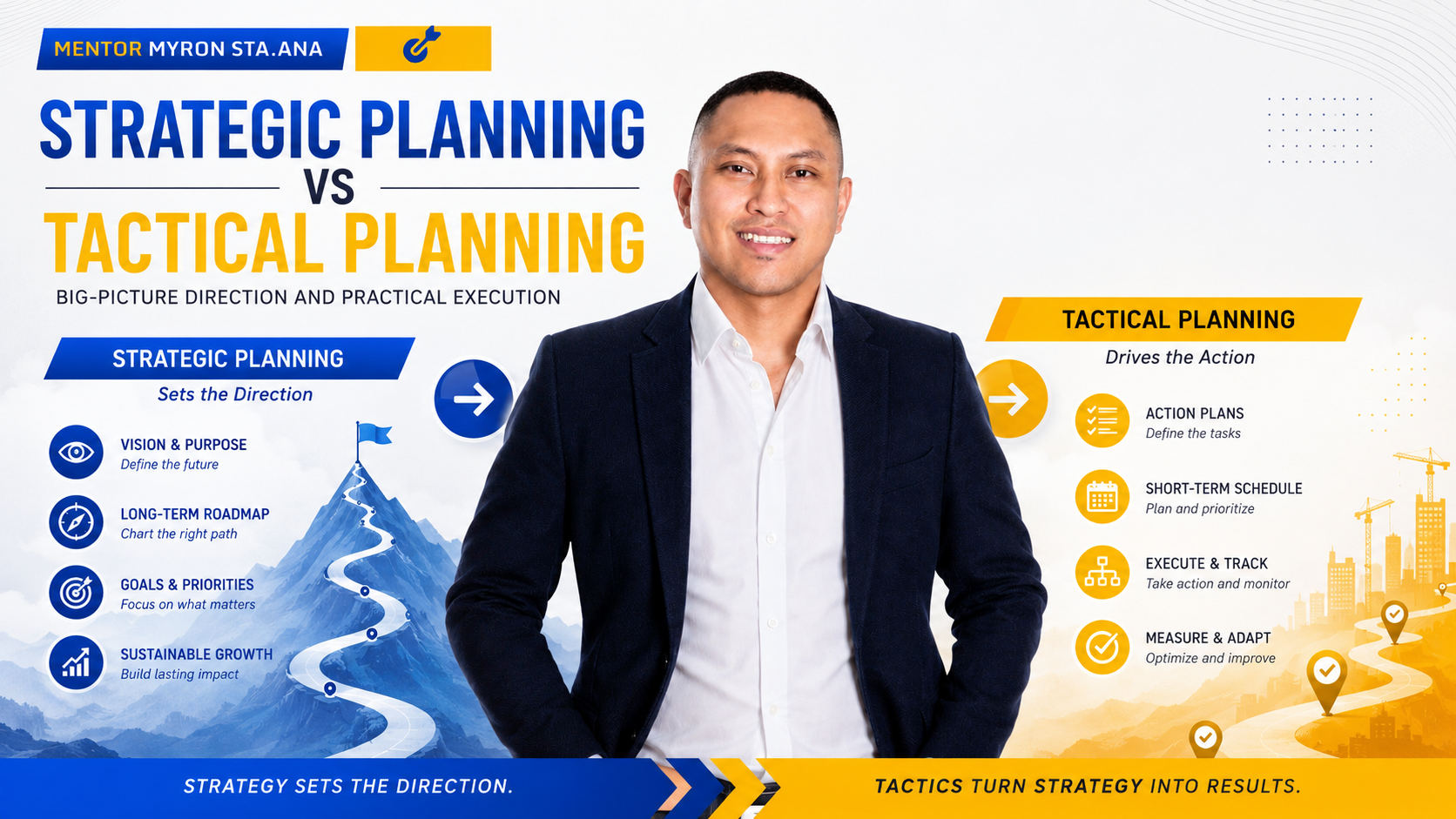
What is Strategic Planning?
Strategic planning is the process of defining the long-term direction of an organization.
It answers the bigger questions:
- Where are we now?
- Where do we want to go?
- What are our most important priorities?
- What major goals should we pursue?
- What competitive advantages should we build?
- What risks and opportunities should we prepare for?
- How will we measure long-term success?
Strategic planning focuses on direction, priorities, positioning, and long-term organizational success.
It is usually led by business owners, executives, board members, senior leaders, department heads, and key decision-makers.
In simple terms:
Strategic planning decides the destination.
What is Tactical Planning?
Tactical planning is the process of translating strategic goals into specific actions, projects, timelines, responsibilities, and short-term execution plans.
It answers practical questions:
- What exactly needs to be done?
- Who will do it?
- When should it be completed?
- What resources are needed?
- What milestones must be achieved?
- How will progress be monitored?
- What problems may affect implementation?
Tactical planning focuses on execution, action steps, responsibilities, schedules, and operational follow-through.
In simple terms:
Tactical planning decides how to get to the destination.
Strategic Planning vs Tactical Planning: The Simple Difference
| Area | Strategic Planning | Tactical Planning |
|---|---|---|
| Main Focus | Long-term direction | Short-term execution |
| Key Question | Where are we going? | How do we get there? |
| Time Horizon | Usually 1 to 5 years | Usually weeks, months, or quarters |
| Led By | Executives, owners, senior leaders | Managers, supervisors, project owners, teams |
| Output | Vision, mission, priorities, goals, KPIs | Action plans, timelines, tasks, owners, milestones |
| Purpose | Create direction and alignment | Implement the plan and produce results |
Strategic planning without tactical planning becomes a document.
Tactical planning without strategic planning becomes scattered activity.
The strongest organizations know how to connect both.
Why Organizations Need Both Strategic and Tactical Planning
Some organizations love big-picture discussions. They talk about vision, growth, transformation, innovation, and future readiness.
That is good.
But if those ideas are not translated into clear actions, nothing much changes after the planning workshop.
Other organizations are action-oriented. They are quick to implement, quick to respond, and quick to solve problems.
That is also good.
But if those actions are not connected to strategy, people may become busy solving today’s problems while ignoring tomorrow’s direction.
This is why strategic and tactical planning must work together.
Strategic planning gives the organization direction.
Tactical planning gives the organization movement.
Strategy tells people what matters.
Tactics tell people what to do next.
Common Problem: Strategic Plans That Do Not Reach Daily Work
One reason strategic plans fail is that they remain too high-level.
The leadership team may understand the strategy, but employees may not know how it affects their daily responsibilities.
For example, the strategic goal may say:
Improve customer satisfaction.
That sounds good, but it is not yet tactical.
A tactical plan should clarify:
- What customer issues should we address?
- Which department owns each improvement?
- What process must change?
- What service standard should be followed?
- What KPI will measure customer satisfaction?
- What timeline should be followed?
- Who reports progress?
Without tactical planning, the strategic goal remains a nice sentence.
With tactical planning, the strategic goal becomes work people can execute.
Example of Strategic Planning and Tactical Planning Working Together
Let us say the organization has this strategic priority:
Improve operational efficiency.
That is strategic.
Now, the tactical plan may include:
- Reduce processing time by 20% within six months
- Map and improve the top three delayed workflows
- Assign process owners per department
- Conduct weekly progress tracking meetings
- Train employees on the revised process
- Monitor turnaround time, error rate, and backlog volume
That is tactical.
Notice the connection.
The strategy gives the direction.
The tactics create the movement.
The KPIs measure the progress.
The accountability system sustains the execution.
Signs Your Organization Has Strategy Without Tactics
Your organization may have strategic planning without strong tactical planning if:
- People know the company goals but do not know their role in achieving them
- The strategic plan is presented once but rarely revisited
- Departments create separate plans that do not connect with each other
- KPIs exist, but action plans are unclear
- Leaders talk about priorities, but teams still focus on routine firefighting
- Projects are launched but not monitored properly
- Accountability is discussed only when targets are missed
When this happens, the issue is not always the quality of the strategy.
Sometimes, the issue is the absence of tactical execution.
Signs Your Organization Has Tactics Without Strategy
Your organization may have tactical activity without clear strategy if:
- People are busy but priorities keep changing
- Teams complete tasks but do not know the bigger purpose
- Departments work hard but move in different directions
- Projects are approved without clear strategic value
- KPIs measure activity instead of real outcomes
- Managers focus only on urgent tasks, not long-term goals
Employees feel productive but not strategically aligned
This creates a culture of motion without direction.
People keep moving, but not always toward the same destination.
The Best Planning Approach: Strategy First, Tactics Next
A practical planning process should follow this flow:
1. Clarify the Strategic Direction
Start with the big picture.
- What is the organization trying to achieve?
- What future position does it want?
- What must change?
- What must improve?
- What must be protected?
- What must be prioritized?
This is where vision, mission, values, strategic priorities, and long-term goals are discussed.
2. Define Strategic Objectives and KPIs
After clarifying direction, the organization must define success.
- What outcomes should be measured?
- What KPIs will show progress?
- What baseline are we starting from?
- What targets should we achieve?
A strategy without measurement is difficult to manage.
3. Translate Strategy into Tactical Action Plans
Once strategic goals and KPIs are clear, leaders and teams must define the tactical plan.
- What actions must be taken?
- Who owns each action?
- What is the timeline?
- What resources are needed?
- What risks should be managed?
- How often will progress be reviewed?
This step turns strategy into execution.
4. Align Departments and Teams
Every department should understand how it contributes to the strategy.
Sales may contribute through revenue growth.
Operations may contribute through efficiency and quality.
HR may contribute through talent development and engagement.
Finance may contribute through budget discipline and financial controls.
IT may contribute through systems improvement and digital support.
Marketing may contribute through brand positioning and lead generation.
Strategy alignment ensures that every department is not just working hard, but working in the same direction.
5. Review, Adjust, and Sustain Execution
Strategic planning and tactical planning should not be one-time events.
Organizations should review progress regularly.
Monthly reviews may focus on tactical execution.
Quarterly reviews may focus on strategic progress.
Annual reviews may refresh strategic direction.
This keeps the plan alive.
Because strategy does not fail only because people forget.
Sometimes, strategy fails because nobody reviews, adjusts, and follows through.
Strategic Planning Needs Tactical Discipline
Many leaders enjoy strategic planning because it feels inspiring.
The workshop energy is high.
Ideas are flowing.
People are engaged.
Everyone is excited.
But after the workshop, the real test begins.
- Can the organization sustain execution?
- Can leaders follow through?
- Can teams align their daily work with the strategic priorities?
- Can managers monitor progress without micromanaging?
- Can employees understand how their work contributes to the bigger picture?
That is why tactical planning is not a minor detail.
It is the bridge between strategic intention and measurable results.
Tactical Planning Needs Strategic Direction
At the same time, tactical planning should not become random task management.
A tactical plan should always be connected to strategy.
Before approving a project, launching an initiative, or assigning a major task, leaders should ask:
- How does this support our strategic priorities?
- Which goal does this contribute to?
- What KPI will it improve?
- Is this urgent only, or is it truly important?
- Will this create long-term value?
This prevents the organization from wasting energy on activities that feel productive but do not move the strategy forward.
Strategic Planning and Tactical Planning in the Philippines
Organizations in the Philippines, whether private companies, government agencies, schools, hospitals, cooperatives, non-profits, or family-owned businesses, often face the same challenge:
They know they need a plan.
But they also need help turning that plan into execution.
This is why many organizations work with a Strategic Planning Consultant in the Philippines, Strategic Planning Facilitator in the Philippines, or Strategic Planning Trainer in the Philippines to help them clarify direction, align teams, develop KPIs, and create tactical action plans.
A good strategic planning process should not only produce a document.
It should produce alignment, ownership, accountability, and movement.
Final Thoughts: Strategy Gives Direction, Tactics Deliver Results
Strategic planning and tactical planning are not competing processes.
They are partners.
Strategic planning gives the organization clarity.
Tactical planning gives the organization action.
Strategic planning defines what matters.
Tactical planning defines what happens next.
Strategic planning aligns the leaders.
Tactical planning mobilizes the teams.
If your organization wants better execution, do not stop at strategy.
Turn your strategy into tactical actions, assign ownership, monitor progress, and build a culture of follow-through.
Because at the end of the day, success does not come from planning alone.
Success comes from aligned execution.
Need Help with Strategic Planning or Tactical Planning?
If your organization needs help creating a clear strategic plan and translating it into practical tactical action plans, Your Strategy Guy can support you as your Strategic Planning Consultant, Facilitator, Trainer, or Speaker in the Philippines.
We can help your team clarify direction, define strategic priorities, develop KPIs, align departments, and create execution-focused action plans that move the organization from planning to measurable results.
A strategic plan gives you the roadmap.
A tactical plan gets the vehicle moving.
And the right facilitator helps make sure everyone is not just riding—but moving in the same direction.
To know more about the author, Mentor Myron Sta. Ana – Your Strategy Guy, you may check his social accounts at:
Tiktok @mentormyronstaana
Instagram @mentormyronstaana