

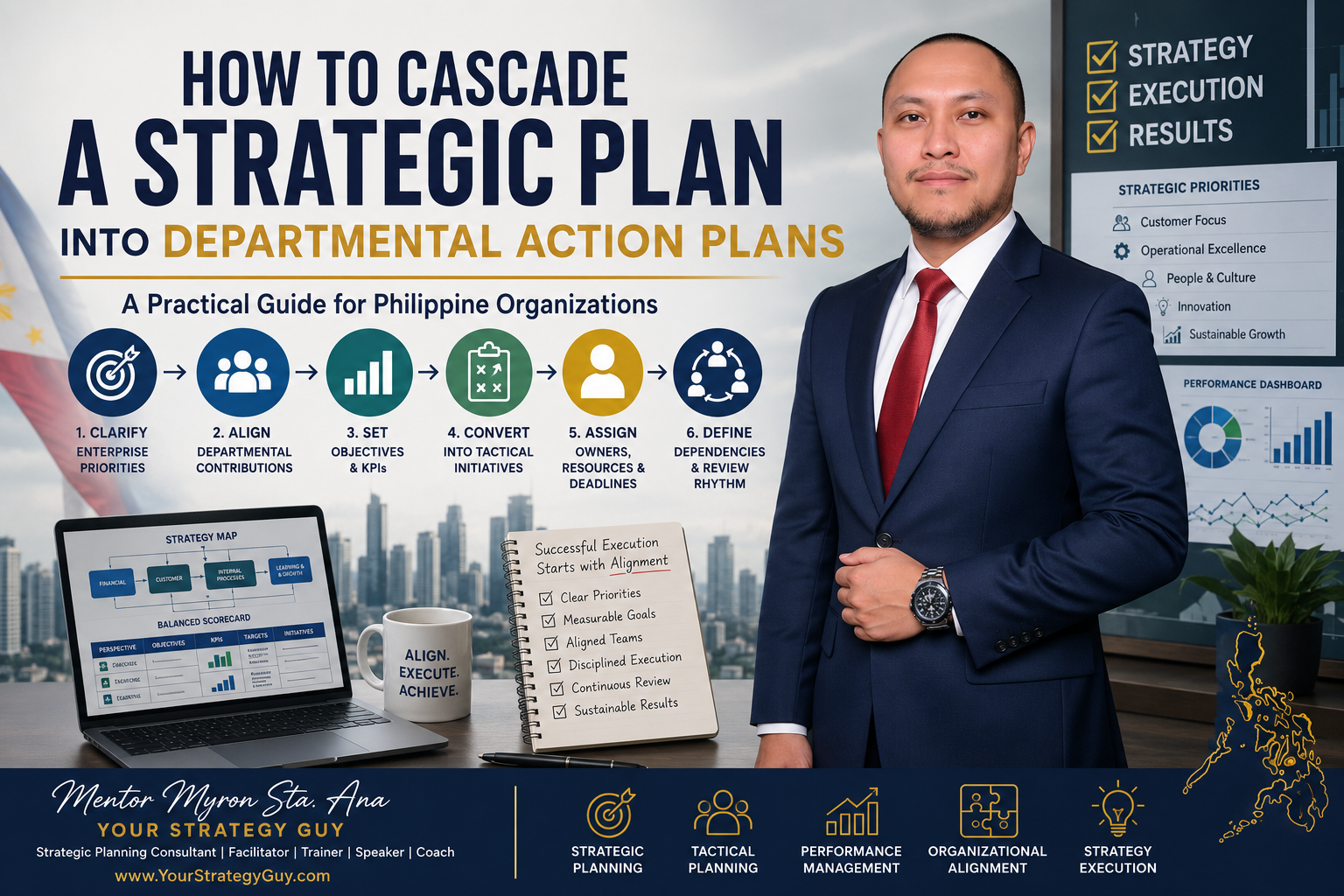
The strategic planning workshop is over.
The leadership team has agreed on the organization’s direction. The strategic priorities have been identified. Goals, objectives, and key performance indicators have been written. Everyone leaves the session feeling inspired, aligned, and ready to move forward.
Then the department heads return to their teams.
That is when the questions begin:
“What exactly does this strategy mean for our department?”
“Which objectives are we responsible for?”
“What should we start doing differently?”
“What KPIs should we monitor?”
“How will our daily work contribute to the company’s long-term goals?”
These questions reveal one of the most important stages of strategy execution: strategic plan cascading.
A strategic plan cannot produce results if it remains only at the executive or organizational level. It must be translated into clear contributions, measurable outcomes, practical initiatives, and specific responsibilities for every department involved in execution.
Without proper cascading, departments may create their own priorities independently, pursue activities that do not support the strategy, or continue with business as usual despite the new strategic direction.
A strategy becomes executable only when people understand what it requires from them.
What Does It Mean to Cascade a Strategic Plan?
Strategic plan cascading is the process of translating organization-wide strategic priorities into aligned objectives, KPIs, initiatives, responsibilities, and action plans for departments, teams, and eventually individual roles.
It connects the organization’s long-term direction with the work performed at lower levels.
For example, an organization may establish this strategic objective:
Improve customer retention and build stronger long-term client relationships.
That objective cannot remain solely with the executive team. Different departments must determine how they will contribute.
Sales may improve account management and client follow-up.
Customer service may strengthen complaint resolution and service recovery.
Operations may reduce delays, defects, or service inconsistencies.
Marketing may create retention and reactivation campaigns.
Human Resources may develop customer experience capabilities.
Information Technology may improve customer data and support systems.
Finance may monitor the profitability and lifetime value of customer segments.
The strategic objective remains organization-wide, but its execution is distributed across several departments.
That is the purpose of cascading: to create a visible connection between enterprise strategy and departmental action.
Cascading Is Not Simply Copying the Corporate Plan
One common mistake is to give every department a copy of the organization’s strategic plan and ask each one to “support” it.
That is communication, but it is not yet cascading.
Another mistake is to copy the same corporate objectives and KPIs into every department’s scorecard. This often creates confusion because not every department has the same degree of influence over every objective.
Effective cascading requires interpretation.
Each department must answer:
- Which strategic objectives can we directly influence?
- What contribution is expected from us?
- What outcomes should our department produce?
- What processes or capabilities must we improve?
- What KPIs can fairly measure our contribution?
- What initiatives must we implement?
- Which other departments must work with us?
- What decisions, resources, and support will we need?
The purpose is not to create smaller copies of the corporate plan.
The purpose is to define how each department will help make the corporate plan happen.
Why Strategic Plan Cascading Matters
A properly cascaded strategy creates clarity at every level.
Department heads understand their strategic responsibilities.
Managers know which results they must prioritize.
Teams see how their projects and processes support organizational goals.
Employees understand why certain changes are being introduced.
Leaders can monitor whether departments are working toward the same direction.
Cascading also reduces the risk of departmental silos.
Without a common strategic reference, each department may focus only on its own concerns. Sales may push for more clients without considering operational capacity. Operations may prioritize cost reduction even when it negatively affects customer experience. Human Resources may launch programs that are disconnected from future capability requirements.
Every department may appear productive while the organization as a whole remains misaligned.
Strategic plan cascading helps ensure that departmental success contributes to organizational success.
The C.A.S.C.A.D.E. Process for Translating Strategy into Departmental Action
Organizations can use the following practical process to cascade their strategic plan.
C — Clarify the Enterprise Priorities
Before asking departments to prepare their action plans, leadership must ensure that the organization-wide strategy is sufficiently clear.
The strategic plan should identify:
- The organization’s desired future direction
- The most important strategic priorities
- The outcomes expected from each priority
- The strategic objectives to be achieved
- The organization-wide KPIs and targets
- The major strategic initiatives
- The planning period and review schedule
Departmental cascading becomes difficult when the corporate strategy is still vague.
Statements such as “achieve excellence,” “become more innovative,” or “improve performance” are too broad unless leadership explains what they mean in measurable and operational terms.
Before cascading begins, leaders must be able to explain:
- What must change?
- Why is the change important?
- What outcomes are expected?
- What should receive greater attention?
- What activities should no longer be prioritized?
- How will success be measured?
People cannot align with a direction they do not clearly understand.
A — Align Departmental Contributions
The next step is to determine how each department contributes to the organization’s strategic objectives.
Not every department must own every objective.
Some departments will serve as primary owners. Others will provide support. Some objectives may require shared cross-functional accountability.
For each strategic objective, ask:
- Which department has the greatest influence over this result?
- Which departments must provide support?
- What specific contribution is expected from each unit?
- What processes, services, decisions, or capabilities must change?
- What dependencies exist among departments?
A contribution matrix can help leadership visualize these relationships.
Departments may be classified as:
Primary Owner — directly accountable for driving the objective.
Supporting Contributor — provides resources, processes, information, or capabilities required for success.
Consulted Department — gives technical input or advice.
Informed Department — must understand the initiative because it may affect its work.
This prevents the common problem of assigning a strategic objective to several departments without clarifying who is ultimately accountable.
Shared execution is necessary, but shared ownership without a clear lead owner often creates weak accountability.
S — Set Departmental Objectives and KPIs
After identifying each department’s contribution, leaders must define the specific outcomes expected from that department.
A departmental objective should not merely repeat the corporate objective. It should explain how the department will contribute to it.
Consider this organization-wide objective:
Increase customer retention from 80% to 90% within the next 12 months.
Possible departmental objectives may include:
Sales: Strengthen key-account engagement and renewal management.
Customer Service: Improve response time and first-contact resolution.
Operations: Reduce service errors and delivery delays affecting customer satisfaction.
Marketing: Increase engagement and reactivation among existing clients.
Human Resources: Build customer experience competencies among client-facing employees.
Each objective should then have appropriate KPIs.
Departmental KPIs may measure:
- Results or outcomes
- Process performance
- Service quality
- Productivity or efficiency
- Timeliness
- Customer or stakeholder experience
- Capability development
- Risk reduction
- Project completion
- Compliance with standards
Avoid creating KPIs simply because data is already available.
A KPI should help leaders determine whether the department is making a meaningful contribution to the strategy.
Every KPI should ideally include:
- A clear definition
- A measurement formula
- A baseline
- A target
- A data source
- A reporting frequency
- A responsible owner
When measurement is unclear, accountability becomes subjective.
C — Convert Objectives into Tactical Initiatives
Departmental objectives explain what must be achieved.
Tactical initiatives explain how the department intends to achieve it.
For every objective, the department should identify the projects, programs, process improvements, campaigns, systems, or interventions required.
For example, if the departmental objective is to improve customer complaint resolution, tactical initiatives may include:
- Redesigning the complaint-handling workflow
- Establishing service-level standards
- Creating an escalation matrix
- Training employees in service recovery
- Introducing a customer feedback dashboard
- Conducting monthly root-cause reviews
- Automating complaint tracking
- Assigning case owners
An initiative should be strategic enough to influence the desired result.
Routine activities should not automatically be listed as strategic initiatives unless they require significant improvement, expansion, or change.
A long list of activities can create the appearance of progress without producing strategic movement.
Departments must distinguish among:
Business-as-usual responsibilities — regular work required to operate.
Improvement actions — changes intended to strengthen current performance.
Strategic initiatives — significant interventions directly connected to strategic objectives.
The strategic plan should focus primarily on actions that move the organization from its current state toward its desired future state.
A — Assign Owners, Resources, and Deadlines
Every tactical initiative must have a clearly identified owner.
The initiative owner is responsible for coordinating implementation, monitoring progress, raising issues, and reporting results.
This does not mean the owner must perform every task personally. It means someone must take responsibility for moving the initiative forward.
Each tactical plan should identify:
- Initiative owner
- Supporting team members
- Start and completion dates
- Major milestones
- Required budget
- Required people and skills
- Technology or equipment requirements
- External partners or suppliers
- Expected output
- Intended outcome
- Key risks
- Progress indicators
Avoid assigning ownership only to a department name.
“Operations,” “Marketing,” or “Human Resources” cannot attend a review meeting, explain a delay, or make a decision. Accountability must ultimately be connected to a person or designated role.
Deadlines should also be realistic.
An unrealistic tactical plan may look ambitious during the workshop but quickly loses credibility during implementation.
Strong planning balances urgency with execution capacity.
D — Define Cross-Functional Dependencies
Many strategic priorities cannot be achieved by one department alone.
Customer experience may require cooperation among Sales, Operations, Customer Service, Information Technology, Finance, and Human Resources.
Digital transformation may require process owners, technical teams, budget approvers, users, and change champions.
Revenue growth may depend on marketing, sales capability, product development, operational capacity, and customer retention.
For every major initiative, identify:
- Which departments must cooperate?
- What must each department provide?
- Which activities must happen first?
- What approvals are required?
- What information must be shared?
- Where might delays or conflicts occur?
- Who will resolve cross-functional issues?
Departments should not finalize tactical plans in isolation.
After each department develops its initial plan, leadership should conduct a cross-functional alignment session to identify overlapping projects, competing demands, resource conflicts, and interdependencies.
This is where the organization moves from several departmental plans to one coordinated execution system.
E — Establish the Review and Accountability Rhythm
A tactical action plan should not disappear after the planning workshop.
The organization must establish a regular strategy execution rhythm.
A practical review structure may include:
Weekly or biweekly project check-ins
These focus on immediate tasks, milestones, issues, and dependencies.
Monthly tactical reviews
These examine departmental KPIs, initiative progress, delays, risks, and corrective actions.
Quarterly strategic reviews
These assess whether the organization is moving toward its strategic objectives and whether assumptions, priorities, or initiatives must be adjusted.
Annual strategy refresh
This examines major changes in the environment and determines whether the strategic direction remains appropriate.
A strategy review should not become another meeting where people merely read reports.
It should support decision-making.
Leaders should discuss:
- What results are on track?
- What results are falling behind?
- What factors are affecting performance?
- Which assumptions have changed?
- What corrective action is required?
- What resources or decisions are needed?
- Which initiatives should continue, change, pause, or stop?
- What lessons should be applied moving forward?
The goal of the review is not to embarrass people whose indicators are red.
The goal is to understand performance, remove obstacles, make decisions, and protect strategic progress.
An Example of Strategic Plan Cascading
Consider a company with this strategic priority:
Build a more efficient, reliable, and customer-focused operation.
Its organization-wide objective may be:
Reduce end-to-end customer processing time by 30% within one year.
This can be cascaded as follows:
Operations
Objective: Simplify and standardize the core customer-processing workflow.
Possible KPIs:
- Average processing time
- Backlog volume
- Error or rework rate
- Percentage of transactions completed within the service standard
Possible initiatives:
- Process mapping
- Workflow redesign
- Elimination of unnecessary approval steps
- Standard operating procedure improvement
Information Technology
Objective: Improve system support and automate repetitive processing steps.
Possible KPIs:
- System availability
- Percentage of transactions automated
- Average system-related delay
- User adoption rate
Possible initiatives:
- Workflow automation
- System integration
- Dashboard development
- User training and technical support
Human Resources
Objective: Build the capabilities required to implement the redesigned process.
Possible KPIs:
- Percentage of affected employees trained
- Post-training proficiency results
- Adoption of revised work standards
- Capability-gap closure rate
Possible initiatives:
- Skills assessment
- Process training
- Coaching for supervisors
- Change communication support
Customer Service
Objective: Provide customers with faster updates and more consistent case resolution.
Possible KPIs:
- Response time
- Resolution time
- Number of follow-ups required
- Customer satisfaction score
Possible initiatives:
- Case-tracking protocol
- Customer update standards
- Escalation procedure
- Service recovery training
Notice that the departments have different objectives, KPIs, and initiatives.
However, all of them contribute to the same organization-wide strategic outcome.
That is alignment.
Common Strategic Plan Cascading Mistakes
1. Cascading Before the Corporate Strategy Is Clear
Departments cannot develop aligned plans when leadership has not finalized its priorities, targets, or strategic choices.
2. Asking Every Department to Support Everything
This creates overloaded scorecards and unclear accountability. Departments should focus on objectives they can genuinely influence.
3. Copying Corporate KPIs into Departmental Scorecards
Corporate results may depend on several departments. Departmental KPIs should measure each unit’s actual contribution.
4. Confusing Activities with Outcomes
“Conduct meetings,” “submit reports,” and “organize training” are activities. The plan must also define what improvement those activities should produce.
5. Creating Too Many Initiatives
Too many projects divide attention, resources, and leadership support. Prioritize initiatives with the strongest strategic value.
6. Ignoring Cross-Functional Dependencies
A department may complete its tasks but still fail to achieve the intended result because another part of the process was not aligned.
7. Assigning Several Owners but No Lead Owner
Collaboration is important, but every initiative still needs one person who is ultimately accountable for coordination and progress.
8. Reviewing Activities but Not Results
A project may be completed without improving the KPI it was supposed to influence. Strategy reviews must examine both implementation and outcomes.
9. Treating the Cascading Workshop as the End
Cascading produces an initial execution plan. Leadership must continue reviewing, learning, adjusting, and communicating.
Who Should Participate in a Strategic Plan Cascading Workshop?
Depending on the organization, participants may include:
- Executives and senior leaders
- Department and business-unit heads
- Managers and supervisors
- Strategic initiative owners
- Finance or budget representatives
- Human Resources or Organizational Development
- Performance management teams
- Planning officers
- Project management representatives
- Process owners
- Selected subject-matter experts
The executive team must remain involved.
Department heads should not be expected to interpret the strategy without sufficient guidance from the leaders who created it.
Senior leaders provide strategic context and make alignment decisions. Department heads translate direction into operational contributions. Managers and technical experts help determine what can realistically be implemented.
What Should a Cascading Workshop Produce?
A well-facilitated cascading process should produce more than discussion.
Its outputs may include:
- Departmental contribution maps
- Aligned departmental objectives
- Departmental KPIs and targets
- Tactical initiatives and projects
- Action plans and timelines
- Assigned initiative owners
- Cross-functional dependency maps
- Resource requirements
- Risk and mitigation plans
- Strategy communication plans
- Monthly and quarterly review schedules
- Departmental or unit scorecards
These outputs should be consolidated and validated before implementation.
Conflicting targets, duplicated initiatives, resource constraints, and unclear responsibilities should be resolved before the plans are formally approved.
Should Every Department Have Its Own Balanced Scorecard?
Not every organization needs to create a highly complex Balanced Scorecard for every department.
The appropriate level of detail depends on the organization’s size, structure, capability, and strategic management maturity.
Some organizations may use:
- A company-wide Balanced Scorecard
- Departmental contribution scorecards
- Unit-level tactical action plans
- Project dashboards
- Individual performance commitments
The system should provide clarity without creating unnecessary administrative work.
A scorecard is useful only when leaders use it to understand performance and make better decisions.
More indicators do not automatically create more control.
Sometimes they only create more reports.
Final Thoughts: Strategy Must Reach the People Who Execute It
A strategic plan may be approved by senior leadership, but it is executed through departments, teams, projects, processes, and individual decisions.
That is why cascading is not simply an administrative step after strategic planning.
It is where organizational direction becomes departmental responsibility.
It is where strategic objectives become measurable contributions.
It is where priorities become initiatives.
It is where initiatives become assigned work.
It is where leadership alignment becomes coordinated execution.
A good strategic plan tells the organization where it wants to go.
A good cascading process helps every department understand how it will help the organization get there.
When people can see the connection between the strategy and their daily work, execution becomes clearer, accountability becomes stronger, and the organization becomes more capable of turning plans into measurable results.
Need Help Cascading Your Strategic Plan?
If your organization already has a strategic plan but needs help translating it into aligned departmental objectives, KPIs, tactical initiatives, and execution plans, you may engage Mentor Myron Sta. Ana – Your Strategy Guy as your strategic planning consultant, facilitator, trainer, speaker, or strategy execution coach in the Philippines.
Mentor Myron can help your organization:
- Validate and clarify its strategic priorities
- Cascade organization-wide objectives to departments
- Develop aligned departmental KPIs
- Create practical tactical action plans
- Define ownership and cross-functional dependencies
- Establish Balanced Scorecards and strategy dashboards
- Facilitate departmental cascading workshops
- Build a sustainable strategy review and accountability system
Do not allow your strategic plan to remain only at the leadership level.
Bring the strategy closer to the people, departments, and teams responsible for turning it into results.
To check out our other articles, click the link below:
To know more about Making Strong Success (MSS) Corporation, check out our social media pages at: