

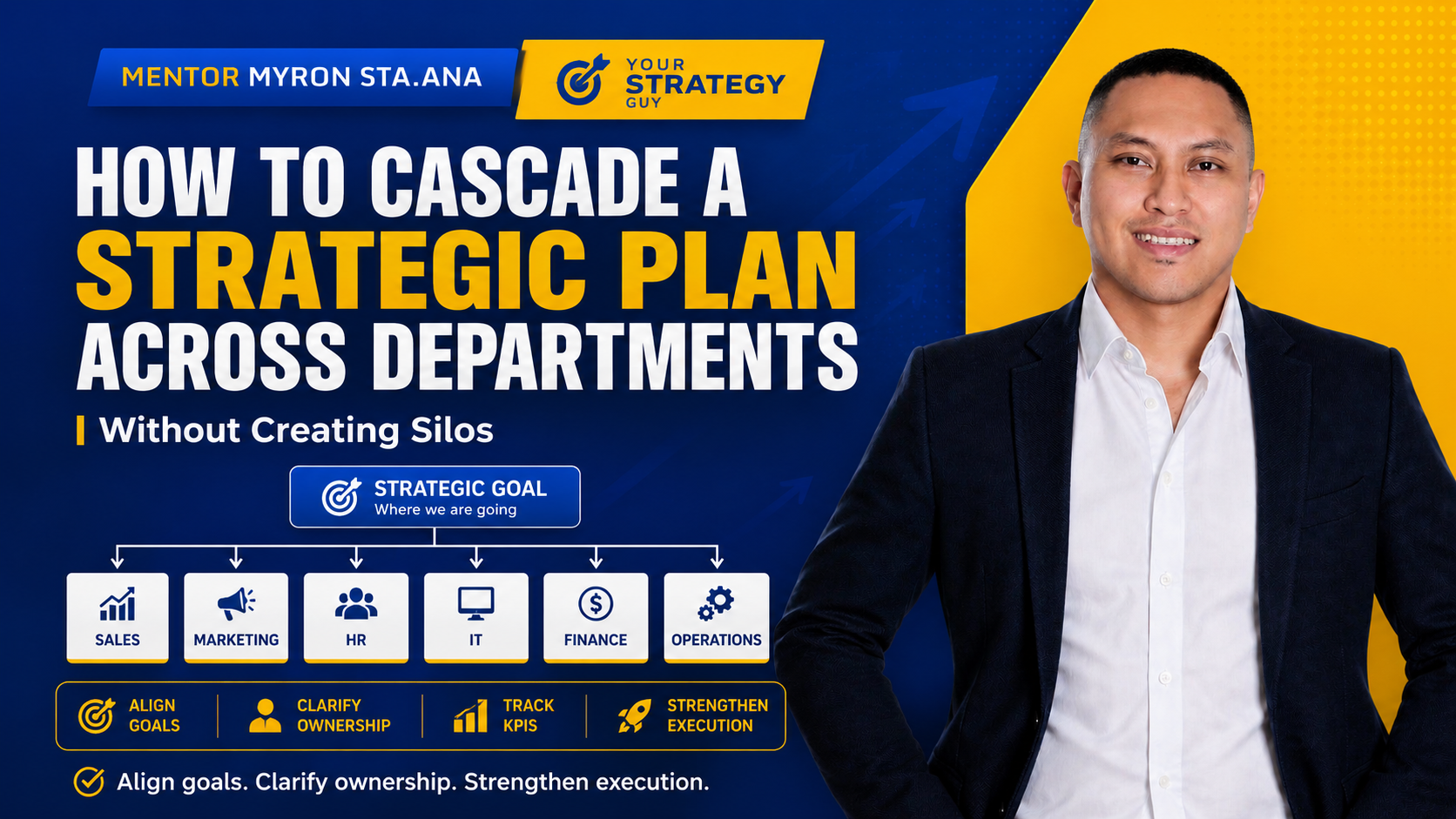
A strategic plan may be clear at the executive level but still fail to influence what departments and employees actually do.
Senior leaders may understand the organization’s vision, strategic priorities, performance targets, and long-term direction. Yet when the plan reaches department heads, managers, supervisors, and employees, the message often becomes fragmented.
Some departments create goals that support the strategy.
Others simply rename their usual activities as “strategic initiatives.”
A few may develop targets that conflict with the priorities of other teams.
Eventually, every department becomes busy implementing its own plan—but the organization is no longer moving as one.
This is the challenge of strategic plan cascading.
Cascading a strategic plan is not merely distributing the final document, presenting it during a town hall, or asking every department to prepare an action plan.
It is the disciplined process of translating organization-wide strategy into aligned departmental goals, KPIs, initiatives, responsibilities, and daily work.
Done well, strategy cascading creates clarity, coordination, accountability, and measurable execution.
Done poorly, it creates more silos.
What Does It Mean to Cascade a Strategic Plan?
To cascade a strategic plan means translating the organization’s highest-level strategic priorities into specific contributions expected from departments, teams, and individuals.
The process connects:
- Organizational vision
- Strategic priorities
- Strategic objectives
- Enterprise-level KPIs
- Departmental goals
- Team deliverables
- Individual responsibilities
- Strategic initiatives
- Monitoring and review systems
The purpose is not to make every department copy the corporate strategy.
The purpose is to help every department answer:
“What must our team accomplish so the organization can achieve its strategy?”
For example, suppose the organization has a strategic objective to:
Increase customer retention.
Different departments may contribute in different ways:
- Sales may strengthen account management and renewal conversations.
- Customer service may improve response and complaint-resolution time.
- Operations may reduce delays and quality issues.
- IT may improve customer-facing systems.
- Finance may streamline billing and payment processes.
- HR may develop customer-service competencies.
- Marketing may improve customer engagement and loyalty campaigns.
Each department contributes differently, but all contributions must lead toward the same strategic outcome.
That is strategy cascading.
Why Strategic Plans Often Fail During Cascading
Many strategic plans weaken after the executive planning workshop because leaders assume the rest of the organization will automatically understand how to implement them.
That rarely happens.
A corporate goal such as “improve operational excellence” may sound meaningful to senior leaders, but employees may still ask:
- What exactly should we improve?
- Which process should we prioritize?
- What does excellence mean in measurable terms?
- Who owns the result?
- How will our department contribute?
- What should we stop doing?
- How will this affect our current workload?
Without clear translation, the strategy remains too broad to guide action.
Several cascading mistakes commonly create this problem.
Mistake 1: Simply Sending the Strategic Plan to Departments
Some organizations complete their strategic plan and then distribute the document through email.
Department heads are instructed to read it and submit their own plans.
This is communication, but it is not alignment.
Different leaders may interpret the strategy differently. Some may focus only on the objectives that directly mention their department. Others may continue their usual programs and place them under the nearest strategic priority.
A strategic plan cannot be cascaded effectively through document distribution alone.
It requires facilitated conversation, interpretation, clarification, and agreement.
Mistake 2: Asking Every Department to Create Independent Goals
Departmental planning is necessary, but completely independent planning can reinforce silos.
For example:
- Sales may prioritize rapid revenue growth.
- Operations may prioritize strict process stability.
- Finance may prioritize aggressive cost reduction.
- HR may prioritize employee-development investments.
- IT may prioritize systems standardization.
All of these may be reasonable goals. But without alignment, they can compete with one another.
Sales may promise customized solutions that operations cannot deliver efficiently.
Finance may reduce budgets for initiatives that HR or IT considers critical.
Marketing may generate demand faster than customer service can support.
The problem is not that departments have goals.
The problem is that those goals were developed without examining interdependencies.
Mistake 3: Cascading KPIs Without Cascading Strategy
Some organizations begin cascading by assigning numerical targets.
The corporate revenue target is divided among business units.
The customer-satisfaction target is assigned to customer service.
The productivity target is assigned to operations.
The training target is assigned to HR.
This may look organized, but KPIs alone do not create alignment.
Teams also need to understand:
- Why the KPI matters
- What strategic objective it supports
- What initiatives will influence it
- Which other departments contribute to it
- What risks could prevent achievement
- Who is accountable for decisions and follow-through
A target without strategic context can become a compliance requirement rather than a shared business priority.
Mistake 4: Treating Support Departments as Separate From Strategy
Strategy is sometimes cascaded mainly to revenue-generating or operational departments.
Support teams such as HR, IT, Finance, Accounting, Procurement, Legal, Administration, and Corporate Communications may be asked only to “support the business.”
That description is too vague.
Support functions should have clear strategic contributions.
For example:
Human Resources
HR may contribute through:
- Workforce capability development
- Leadership readiness
- Succession planning
- Employee engagement
- Strategic workforce planning
- Performance-management alignment
Information Technology
IT may contribute through:
- Digital transformation
- Systems availability
- Data accuracy
- Cybersecurity
- Process automation
- Technology adoption
Finance
Finance may contribute through:
- Resource allocation
- Financial forecasting
- Cost optimization
- Cash-flow management
- Investment analysis
- Strategic performance reporting
Administration and Procurement
These teams may contribute through:
- Service reliability
- Vendor performance
- Resource availability
- Turnaround time
- Compliance
- Cost efficiency
Every function must be able to explain how its work contributes to strategic outcomes.
Mistake 5: Converting Every Routine Activity Into a Strategic Initiative
Not every task is strategic.
Preparing reports, processing documents, attending meetings, responding to requests, and performing routine transactions may be important—but they are not automatically strategic initiatives.
A strategic initiative should create meaningful movement toward a strategic objective.
For example:
Routine activity:
Prepare monthly customer reports.
Strategic initiative:
Implement a customer-retention analytics system that identifies high-risk accounts and triggers proactive engagement.
Routine activity:
Conduct employee training.
Strategic initiative:
Develop and implement a leadership pipeline program for mission-critical supervisory roles.
Routine activities sustain operations.
Strategic initiatives change, improve, expand, or strengthen organizational capability.
Both matter, but they should not be confused.
A Practical Process for Cascading Strategy Across Departments
Organizations can use the following process to translate enterprise strategy into aligned departmental execution.
Step 1: Clarify the Organization-Wide Strategic Priorities
Before cascading begins, leadership must ensure that the strategic plan is clear enough to be translated.
Every strategic priority should answer:
- What outcome are we trying to achieve?
- Why is this important?
- How will success be measured?
- What major changes are required?
- What capabilities must be strengthened?
- What must departments do differently?
A vague objective such as “become more competitive” will be difficult to cascade.
A clearer objective would be:
Improve market competitiveness by increasing customer retention, reducing delivery lead time, and launching two new service offerings within the planning period.
The clearer the enterprise strategy, the easier it becomes for departments to identify their contributions.
Step 2: Identify Enterprise-Level Strategic Objectives and KPIs
The organization should define a manageable number of strategic objectives and performance measures.
Examples may include:
- Increase revenue from priority markets
- Improve customer retention
- Reduce operational turnaround time
- Strengthen leadership capability
- Improve employee productivity
- Increase digital adoption
- Improve financial sustainability
- Strengthen service quality
Each objective should have relevant KPIs, baselines, targets, and accountable executive owners.
Departments cannot align themselves properly when the organization has not clearly defined what success looks like.
Step 3: Map Departmental Contributions
Each department should review every enterprise strategic objective and determine its level of contribution.
A simple contribution-mapping table can be used:
| Strategic Objective | Department Contribution | Level of Influence | Required Collaboration |
|---|---|---|---|
| Improve customer retention | Reduce complaint-resolution time | High | Customer Service, IT, Operations |
| Improve profitability | Reduce process waste and rework | Medium | Finance, Quality, Operations |
| Strengthen leadership pipeline | Identify and develop successors | High | HR, Department Heads |
| Improve digital adoption | Train users and improve system usability | High | IT, HR, Operations |
Departments do not need to own every objective.
They may serve as:
- Primary owner
- Co-owner
- Contributor
- Support function
- Data provider
- Review participant
Clarifying the type of contribution prevents both duplication and neglect.
Step 4: Translate Strategic Objectives Into Departmental Outcomes
After contribution mapping, each department should define the outcomes it must deliver.
A departmental outcome should be more specific than a general statement of support.
Weak departmental objective:
Support customer satisfaction.
Stronger departmental objective:
Reduce average customer complaint-resolution time from five business days to two business days by the fourth quarter.
Weak departmental objective:
Improve employee development.
Stronger departmental objective:
Achieve at least 80% competency readiness for identified supervisory successors by year-end.
The departmental outcome should clearly connect to the enterprise objective while remaining within the department’s area of influence.
Step 5: Develop Aligned Departmental KPIs
Departmental KPIs should measure meaningful contributions to strategy.
Good KPIs are not simply activity counts.
For example, HR may track:
Activity measure:
Number of training hours delivered.
Strategic performance measure:
Percentage of employees who achieved required competency levels after development interventions.
IT may track:
Activity measure:
Number of system tickets closed.
Strategic performance measure:
Percentage reduction in downtime affecting critical business processes.
Marketing may track:
Activity measure:
Number of social-media posts published.
Strategic performance measure:
Number and quality of qualified leads generated from priority market segments.
The question is not only, “What did we do?”
The stronger question is:
“What strategic outcome did our work influence?”
Step 6: Identify Cross-Functional Dependencies
Most strategic objectives cannot be achieved by one department alone.
Customer experience may require coordination among:
- Sales
- Marketing
- Operations
- IT
- Finance
- Customer service
Employee productivity may require coordination among:
- HR
- Department managers
- IT
- Administration
- Finance
Digital transformation may require coordination among:
- IT
- Operations
- HR
- Finance
- Risk and compliance
- End users
A cascading workshop should identify:
- Which departments depend on one another
- What each team must deliver
- When handoffs should occur
- What shared KPIs should be monitored
- Who resolves cross-functional conflicts
Without this step, departmental scorecards may look aligned on paper while teams continue operating separately.
Step 7: Define Strategic Initiatives and Action Plans
Once objectives and KPIs are clear, departments should identify the initiatives needed to achieve them.
Each initiative should include:
- Clear description
- Strategic objective supported
- Expected outcome
- Accountable owner
- Supporting departments
- Timeline
- Required resources
- Milestones
- Success indicators
- Risks and mitigation actions
A strategic initiative is not complete because it has a project name.
It must have ownership, resources, deadlines, and measurable impact.
Step 8: Align Budgets and Resources With Strategy
A strategic plan cannot be implemented when resources remain committed mainly to old priorities.
During cascading, leaders should review:
- Department budgets
- Workforce requirements
- Technology investments
- Training needs
- External suppliers
- Capital expenditures
- Project capacity
- Management attention
An organization may claim that digital transformation is a priority, but the strategy will not move if there is no budget for technology, process redesign, or capability development.
Resource allocation reveals whether the organization is truly committed to its stated priorities.
Step 9: Translate Departmental Plans Into Team and Individual Commitments
Strategy should eventually influence what teams and individuals are expected to accomplish.
However, this does not mean every corporate KPI should be copied into every employee’s performance plan.
Individual commitments should reflect the person’s actual role and level of control.
For example, an enterprise objective to improve customer retention may translate into:
- An account manager’s commitment to conduct quarterly client reviews
- A customer-service employee’s commitment to meet response standards
- An operations supervisor’s commitment to reduce service errors
- An IT specialist’s commitment to resolve system incidents within agreed service levels
This creates a visible line from individual contribution to organizational strategy.
Step 10: Establish a Strategy Review Rhythm
Cascading does not end when departmental plans are submitted.
The organization needs a review system that keeps strategy active.
A practical review rhythm may include:
Monthly Department Reviews
Focus on:
- Action-plan progress
- KPI movement
- Project milestones
- Immediate barriers
- Resource concerns
Quarterly Strategy Reviews
Focus on:
- Enterprise-level objectives
- Cross-functional issues
- Strategic risks
- Initiative performance
- Changes in assumptions
- Decisions requiring executive attention
Annual Strategy Refresh
Focus on:
- Environmental changes
- Strategic relevance
- Performance trends
- Emerging opportunities
- Priority adjustments
- New planning-period requirements
A strategy that is not regularly discussed will eventually be replaced by urgent operational concerns.
How the Balanced Scorecard Supports Strategy Cascading
The Balanced Scorecard can provide a practical framework for cascading strategy because it organizes objectives across multiple performance perspectives.
These typically include:
- Financial
- Customer or stakeholder
- Internal process
- Learning and growth
At the enterprise level, the organization develops strategic objectives and KPIs under these perspectives.
Departments can then identify how they contribute to each objective.
For example:
| Enterprise Objective | Departmental Contribution |
|---|---|
| Improve profitability | Finance strengthens cost analysis; Operations reduces waste; Sales improves margins |
| Improve customer loyalty | Customer Service improves resolution; IT enhances digital experience; Operations improves reliability |
| Improve process efficiency | Operations redesigns workflows; IT automates processes; HR develops required competencies |
| Strengthen organizational capability | HR develops talent; Leaders coach employees; IT improves knowledge systems |
This creates a structured line of sight between strategy and departmental performance.
However, Balanced Scorecard cascading should not become a mechanical exercise where every department creates four objectives under four perspectives just to complete a form.
The scorecard must reflect real strategic contribution.
Should Every Department Have Its Own Scorecard?
Not always.
The answer depends on the size, complexity, and management maturity of the organization.
A separate departmental scorecard may be useful when:
- The department has major strategic responsibilities
- Its performance significantly affects enterprise outcomes
- It manages multiple strategic initiatives
- It has clearly defined customers or stakeholders
- Its KPIs require regular leadership review
Smaller teams may use a simpler departmental action plan linked to the enterprise scorecard.
The objective is not to create more documents.
The objective is to improve strategic clarity and execution.
Questions Every Department Should Answer During Strategy Cascading
Each department should be able to answer the following:
- Which organizational strategic objectives do we directly influence?
- What outcomes must our department deliver?
- Which KPIs will measure our contribution?
- What initiatives must we implement?
- Which departments must we work with?
- What resources do we need?
- What existing activities should we stop, reduce, or redesign?
- What risks could prevent execution?
- Who is accountable for each commitment?
- How often will we review progress?
When these questions are answered clearly, strategy becomes more practical and actionable.
The Role of Leaders in Strategy Cascading
Leaders play a critical role in preventing the cascading process from becoming an administrative exercise.
They must:
- Explain the strategic context
- Clarify priorities
- Resolve conflicting goals
- Encourage cross-functional cooperation
- Assign accountability
- Remove execution barriers
- Review performance consistently
- Model strategic discipline
Leaders should also avoid communicating that every existing activity is equally important.
Strategy requires choices.
If everything is a priority, nothing is a priority.
Why Organizations Engage a Strategy Alignment Facilitator
Strategy cascading can become difficult when departments have competing priorities, unclear responsibilities, or different interpretations of the strategic plan.
An external Strategic Planning Facilitator in the Philippines or Strategy Alignment Consultant in the Philippines can help by:
- Structuring the cascading process
- Facilitating departmental contribution mapping
- Clarifying strategic objectives
- Aligning cross-functional expectations
- Developing meaningful KPIs
- Identifying duplicated or conflicting initiatives
- Strengthening ownership and accountability
- Creating a practical strategy-review system
A facilitator does not replace leadership decision-making.
The facilitator helps leaders and teams reach clearer, more aligned, and more actionable decisions.
Final Thoughts: Cascading Is Where Strategy Becomes Real
Strategic planning creates direction.
Strategy cascading converts that direction into organizational movement.
It connects the boardroom to departments.
It connects departments to teams.
It connects teams to individual responsibilities.
It connects goals to KPIs.
It connects KPIs to initiatives.
And it connects plans to measurable execution.
A strategic plan should not remain something understood only by senior leaders.
Every part of the organization should know:
- What the strategy means
- Why it matters
- How they contribute
- What they must deliver
- How success will be measured
That is how strategy moves from presentation to performance.
Need Help Cascading Your Strategic Plan?
If your organization already has a strategic plan but needs help translating it into aligned departmental goals, KPIs, initiatives, and accountability systems, Your Strategy Guy can support you as your:
- Strategic Planning Consultant in the Philippines
- Strategy Alignment Facilitator in the Philippines
- Balanced Scorecard Consultant in the Philippines
- KPI Development Trainer in the Philippines
- Strategy Execution Speaker or Resource Person
A strong strategy should not stop at the executive level.
It should guide every department, every team, and every important decision.
Cascade the strategy clearly. Align the organization deliberately. Execute the plan consistently.
To know more about Your Strategy Guy, visit his social media pages at Facebook, LinkedIn, Instagram