

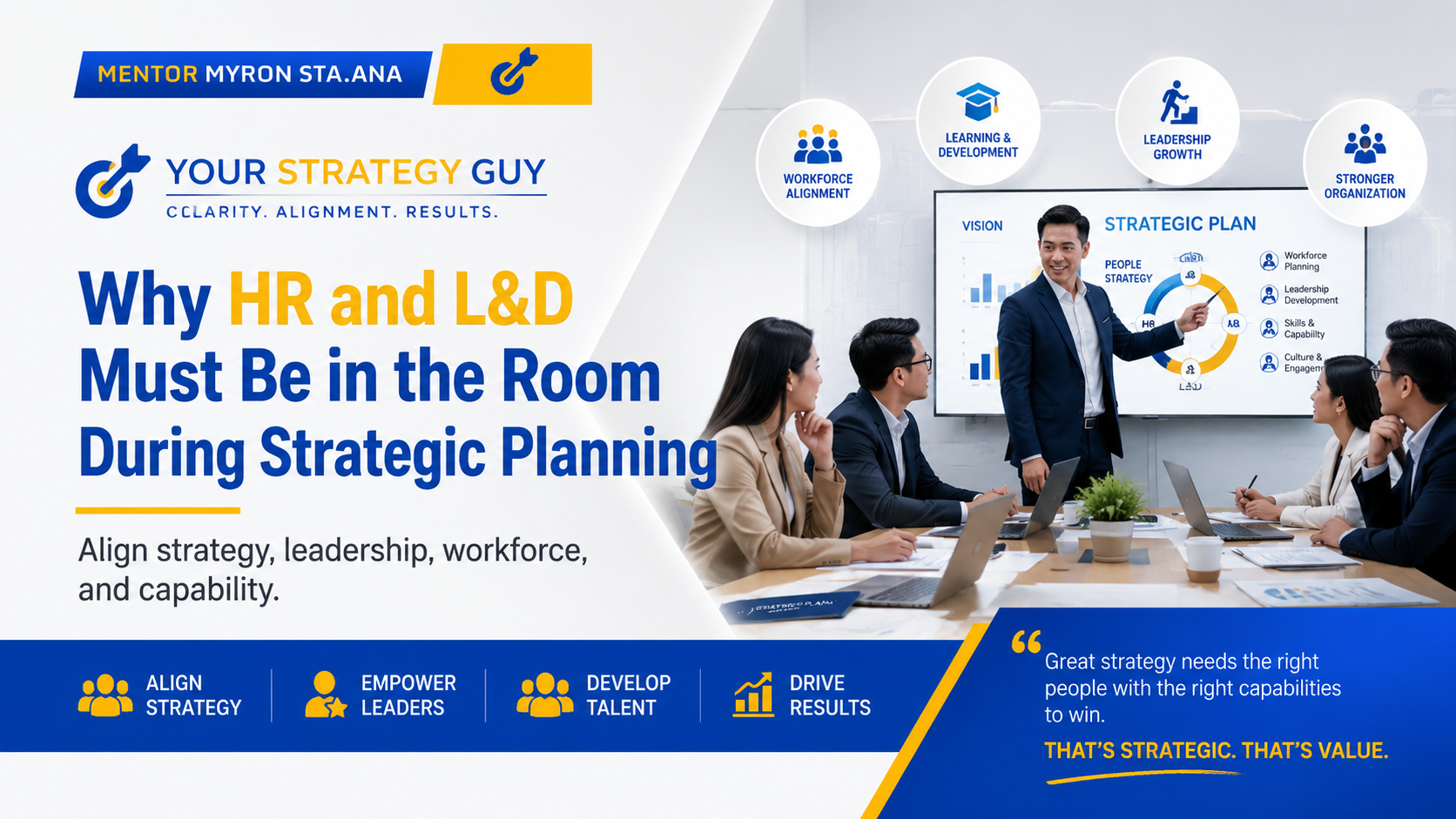
Why HR and L&D Must Be in the Room During Strategic Planning
In many organizations, strategic planning is treated primarily as a concern of business owners, executives, finance leaders, operations heads, and corporate planning teams.
Senior leaders gather in a room to review business performance, discuss market realities, define priorities, establish targets, and identify major initiatives.
Once the strategic plan has been completed, Human Resources and Learning and Development are called in.
Their instructions often sound like this:
“Please prepare the people for the strategy.”
“Develop a training plan that supports these goals.”
“Communicate the new direction to employees.”
“Make sure our managers can execute this.”
There is only one problem.
By that time, many of the most important people-related decisions have already been made—without fully examining whether the organization has the workforce, leadership, competencies, behaviors, structure, culture, and capacity required to execute them.
HR and L&D should not be invited only after the strategic plan is finished.
They should be in the room while the strategy is being developed.
Because every strategy eventually becomes a people question.
Do we have the right people?
Do they have the required capabilities?
Are the roles and responsibilities clear?
Can our leaders guide the transition?
Will employees support the direction?
Does our culture reinforce or resist the strategy?
Can the organization sustain the expected level of performance?
A strategy may look financially sound and operationally attractive, but it can still fail when the organization is not ready to execute it.
That is why HR and Learning and Development must become strategic partners—not merely implementers of programs after the planning workshop.
Strategic Planning Is Also Workforce Planning
Every strategic priority creates workforce implications.
If a company wants to expand into new markets, it may need:
- Additional sales capability
- Stronger account management
- Market research expertise
- New operational roles
- Leadership capacity in new locations
- Cross-cultural or regional competencies
If an organization wants to improve customer experience, it may need:
- Customer-service capability
- Process ownership
- Better internal coordination
- Stronger problem-solving
- Improved communication
- Leadership accountability for service standards
If the strategy involves digital transformation, it may require:
- Digital skills
- Process redesign
- Change management
- Data literacy
- Technology adoption
- New performance measures
- Different ways of working
If the organization wants to improve profitability, it may need:
- Commercial awareness
- Cost-conscious decision-making
- Process-improvement skills
- Financial literacy among managers
- Better resource utilization
- Stronger performance accountability
The business strategy defines what the organization wants to accomplish.
The workforce strategy determines whether the organization has the human capability to accomplish it.
These two should never be developed separately.
Why Involving HR Only After Strategic Planning Is Too Late
When HR receives the completed strategic plan only after leadership has finalized it, HR is placed in a reactive position.
It must interpret broad business priorities and quickly convert them into recruitment, development, performance management, engagement, and organizational-development activities.
The result may be a collection of disconnected responses:
- Recruit more people
- Conduct leadership training
- Launch a culture program
- Revise performance-appraisal forms
- Organize employee-engagement activities
- Offer technical courses
- Communicate the company direction
These actions may be helpful, but they do not automatically address the real capability requirements of the strategy.
For example, leadership may conclude that the company needs “better managers.”
HR may then arrange a generic leadership program.
But what specific leadership capabilities does the strategy require?
Do managers need to:
- Lead organizational change?
- Improve cross-functional collaboration?
- Coach underperforming employees?
- Manage remote or hybrid teams?
- Strengthen commercial decision-making?
- Improve execution discipline?
- Build customer-focused teams?
- Develop successors?
Without strategic clarity, leadership development becomes broad rather than targeted.
Training may be delivered successfully, participants may enjoy the program, and evaluation scores may be high—but the intervention may not improve the business capability the strategy actually needs.
The Strategic Contributions of HR and L&D
HR and L&D bring a different but essential perspective to strategic planning.
Business leaders may naturally focus on markets, revenue, customers, operations, technology, growth, and financial performance.
HR and L&D help leadership examine the organizational capability behind those ambitions.
Here are the strategic contributions they should make during the planning process.
1. Translating Strategic Priorities Into Capability Requirements
Every strategic priority should be examined through a capability lens.
Suppose the organization identifies the following strategic objective:
Expand revenue from key corporate accounts.
The planning team should not stop after setting a revenue target.
It should ask:
- What capabilities must the sales team strengthen?
- Do account managers understand consultative selling?
- Can they analyze client needs?
- Can they manage long-term relationships?
- Do sales leaders coach performance effectively?
- Can operations support customized client requirements?
- Does finance provide timely commercial information?
- Can customer-service teams manage complex accounts?
HR and L&D can help convert a strategic goal into a capability map.
A practical sequence is:
Strategic priority
→ Required business outcomes
→ Critical roles and processes
→ Required competencies and behaviors
→ Capability gaps
→ Workforce and learning interventions
This prevents training from becoming a list of popular topics disconnected from strategic requirements.
2. Identifying Workforce Gaps Before They Become Execution Problems
A strategy may require more people, different skills, stronger leadership, or redesigned roles.
HR should help leadership examine:
- Current workforce capacity
- Critical-position vacancies
- Skills shortages
- Leadership readiness
- Succession risks
- Employee productivity
- Retention concerns
- Role duplication
- Workload distribution
- Future staffing requirements
For example, a company may plan to open three new branches within one year.
The financial projections may be attractive, but the organization must still determine:
- Who will lead the new branches?
- Are internal successors ready?
- How long will recruitment take?
- What competencies must branch employees have?
- Who will train and onboard them?
- Can existing support teams handle the additional demand?
- What cultural and service standards must be replicated?
Without this workforce analysis, expansion may proceed faster than organizational readiness.
The company may successfully open new locations but struggle with inconsistent leadership, customer experience, productivity, and operational control.
3. Determining Whether the Organization Structure Supports the Strategy
Sometimes, the problem is not a lack of effort or capability.
The structure itself may be preventing execution.
HR and organizational-development leaders should help examine:
- Reporting relationships
- Decision-making authority
- Role clarity
- Span of control
- Departmental responsibilities
- Cross-functional coordination
- Accountability for shared outcomes
- Duplication of work
- Bottlenecks in approvals
For example, an organization may prioritize faster customer response but retain an approval process that requires several management levels.
It may want departments to collaborate, yet reward them only for isolated departmental targets.
It may want managers to coach employees but overload them with administrative work.
It may want innovation but punish reasonable experimentation and mistakes.
Strategic planning should therefore ask:
Does our current organization design enable the strategy—or work against it?
HR helps leadership recognize when roles, structures, policies, and performance systems need to change.
4. Defining the Behaviors and Culture Required for Execution
Strategy is not executed only through projects and KPIs.
It is also executed through everyday behavior.
If the organization wants stronger collaboration, people must be willing to share information, coordinate decisions, and solve problems across departmental boundaries.
If it wants innovation, employees must be able to question old practices, suggest improvements, experiment responsibly, and learn from mistakes.
If it wants customer centricity, teams must take ownership of customer outcomes rather than passing concerns from one department to another.
If it wants execution discipline, leaders and employees must follow through on commitments, monitor progress, and address problems promptly.
HR and L&D should help define:
- What behaviors will strengthen the strategy?
- What behaviors may weaken it?
- What leadership practices must be reinforced?
- What cultural habits must change?
- How will desired behaviors be modeled, measured, and recognized?
Core values become strategically useful only when they are translated into observable workplace behaviors.
Words such as excellence, integrity, teamwork, innovation, and accountability must be made specific.
Otherwise, they remain inspiring concepts rather than execution standards.
5. Building the Leadership Capability Required by the Strategy
Different strategies require different leadership capabilities.
A strategy focused on rapid growth may require leaders who can:
- Delegate effectively
- Develop successors
- Build scalable systems
- Manage changing priorities
- Maintain culture during expansion
A strategy focused on operational excellence may require leaders who can:
- Analyze performance gaps
- Improve processes
- Enforce standards
- Coach for consistency
- Use data in decision-making
A transformation strategy may require leaders who can:
- Communicate change
- Manage resistance
- Create psychological safety
- Sustain employee engagement
- Lead through uncertainty
A customer-experience strategy may require leaders who can:
- Model customer focus
- Remove service barriers
- Coordinate across departments
- Coach frontline behavior
- Resolve recurring customer issues
Instead of asking only, “Do our managers need leadership training?” the organization should ask:
“What leadership capabilities does this strategy require, and where are our current gaps?”
This produces a more focused leadership-development agenda.
6. Connecting Performance Management With Strategic Priorities
Employees often receive mixed messages when the strategic plan says one thing but the performance-management system rewards another.
The organization may claim that collaboration is a priority, but employees are evaluated only on individual output.
It may emphasize innovation, but managers penalize unsuccessful ideas.
It may prioritize customer satisfaction, but teams are measured mainly on speed or volume.
It may encourage long-term capability building, but reward only short-term financial results.
HR should help ensure that:
- Organizational goals are cascaded appropriately
- Departmental KPIs support enterprise priorities
- Individual goals reflect actual role contributions
- Performance measures balance activity and outcomes
- Leadership behavior is evaluated
- Recognition reinforces strategic priorities
- Accountability is clear
Performance management should make the strategy visible in the daily expectations placed on people.
When employees cannot see the connection between the strategic plan and their performance goals, alignment remains incomplete.
7. Designing a Learning Strategy Instead of a Training Calendar
Many organizations prepare an annual training calendar by asking departments what programs they want.
The result may include:
- Communication training
- Leadership training
- Customer-service training
- Time-management training
- Team building
- Technical courses
- Wellness activities
These may all have value.
However, a collection of requested courses is not yet a learning strategy.
A learning strategy should begin with business direction.
It should answer:
- What strategic goals must learning support?
- What competencies are critical to execution?
- Which employee groups need development?
- What performance gaps can training address?
- What non-training interventions are also required?
- How will learning be applied at work?
- How will business impact be measured?
L&D should not ask only:
“What training programs should we conduct?”
It should ask:
“What capabilities must the organization build to execute its strategy successfully?”
That question changes the role of L&D from training coordinator to business capability partner.
8. Preparing Employees for Strategic Change
A new strategy often requires people to:
- Use new systems
- Follow redesigned processes
- Assume different responsibilities
- Serve new customer segments
- Adopt new performance standards
- Work with different departments
- Learn new technologies
- Change established habits
Even a technically sound strategic initiative can fail when employees do not understand, accept, or adopt the change.
HR and L&D can help leadership plan:
- Stakeholder analysis
- Change communication
- Manager briefings
- Employee involvement
- Capability development
- Resistance management
- Reinforcement mechanisms
- Adoption monitoring
Change management should not begin when resistance becomes visible.
It should be built into the strategic plan from the start.
The Strategy-to-Capability Alignment Framework
Organizations can use the following framework during strategic planning to connect business direction with workforce and learning requirements.
| Strategic Planning Question | Capability Question |
|---|---|
| What are we trying to achieve? | What capabilities will achievement require? |
| What must change in the business? | What must people do differently? |
| What processes must improve? | What skills and behaviors support those processes? |
| What strategic initiatives will be launched? | Which roles will lead and execute them? |
| What targets must be reached? | What performance standards must employees meet? |
| What risks may affect execution? | What workforce or leadership risks must be addressed? |
| How will success be measured? | How will capability development and application be measured? |
This discussion should result in a Strategic Capability Agenda containing:
- Critical organizational capabilities
- Priority employee groups
- Competency gaps
- Leadership-development requirements
- Recruitment or redeployment needs
- Succession priorities
- Culture and behavior requirements
- Learning interventions
- Non-training interventions
- Capability KPIs
- Accountable owners
- Implementation timelines
Examples of Connecting Business Strategy With HR and L&D
Strategic Priority: Improve Customer Experience
Possible people and capability requirements:
- Customer-needs analysis
- Service communication
- Complaint management
- Cross-functional problem-solving
- Process ownership
- Customer-focused leadership
- Service-quality coaching
Possible HR and L&D interventions:
- Customer-experience competency framework
- Service-behavior standards
- Coaching for frontline supervisors
- Cross-functional service-recovery simulations
- Performance KPIs linked to customer outcomes
- Recognition for customer-focused behavior
Strategic Priority: Accelerate Digital Transformation
Possible people and capability requirements:
- Digital literacy
- Data interpretation
- Process redesign
- Technology adoption
- Change leadership
- Cybersecurity awareness
- Agile collaboration
Possible HR and L&D interventions:
- Digital skills assessment
- Role-based technology training
- Change-leadership development
- User-adoption support
- Digital champions program
- Revised job descriptions and competencies
- Adoption and proficiency measures
Strategic Priority: Expand Into New Markets
Possible people and capability requirements:
- Market intelligence
- Consultative selling
- Commercial decision-making
- New-market leadership
- Cultural awareness
- Strategic account management
- Scalable operational capability
Possible HR and L&D interventions:
- Strategic workforce plan
- Leadership-succession review
- New-role recruitment
- Market-entry capability program
- Sales and account-management development
- Onboarding and culture-transfer plan
Strategic Priority: Improve Operational Efficiency
Possible people and capability requirements:
- Process analysis
- Root-cause problem-solving
- Continuous improvement
- Data-based decision-making
- Quality discipline
- Cost awareness
- Performance coaching
Possible HR and L&D interventions:
- Process-improvement training
- Problem-solving simulations
- Supervisor coaching program
- Financial literacy for non-finance managers
- Revised productivity measures
- Continuous-improvement recognition system
Warning Signs That HR and L&D Are Disconnected From Strategy
Your organization may have a strategy-capability disconnect when:
- HR receives the strategic plan only after it has been approved
- The training calendar is based mainly on requests or popular topics
- Leadership programs are generic rather than strategy-specific
- Training success is measured mostly through attendance and satisfaction
- Strategic initiatives repeatedly experience skills or staffing problems
- New systems are launched without adequate user preparation
- High-potential employees are identified without reference to future strategic roles
- Departmental KPIs do not reinforce strategic behaviors
- Culture programs are separated from business priorities
- Managers are expected to execute change without change-leadership support
- Business leaders see HR and L&D mainly as service providers
- HR and L&D struggle to explain how their work affects organizational results
These signs indicate that people development is being managed as a support activity rather than a strategic capability.
What HR and L&D Should Bring to a Strategic Planning Workshop
HR and L&D representatives should come prepared with relevant information, not just general observations.
Useful inputs include:
- Workforce profile
- Attrition and retention patterns
- Critical vacancies
- Succession readiness
- Leadership-pipeline status
- Competency-assessment results
- Employee-engagement findings
- Productivity indicators
- Performance trends
- Training effectiveness data
- Workforce-capacity issues
- Culture and behavior concerns
- Emerging skills requirements
- Organizational-development priorities
They should also be ready to ask challenging questions such as:
- Do we have enough leadership capacity to execute this plan?
- Which strategic roles are difficult to fill?
- What competencies are missing?
- What behavior changes will this strategy require?
- Which teams will experience the greatest change?
- What resistance should we anticipate?
- What must managers do differently?
- How long will capability building take?
- Which current HR systems may conflict with the strategy?
- How will we measure whether people are ready?
These questions help the planning team move from aspiration to organizational reality.
The Role of Business Leaders
HR and L&D cannot create strategic alignment alone.
Business leaders must also stop treating people-related issues as matters that HR should solve independently.
Executives and department heads must:
- Define the capabilities their strategies require
- Participate in workforce and competency discussions
- Own the development of their people
- Provide opportunities for workplace application
- Coach and reinforce desired behaviors
- Review capability indicators alongside business KPIs
- Hold leaders accountable for talent development
- Allocate sufficient time and resources
HR can provide frameworks, data, systems, and expertise.
L&D can design learning interventions.
But business leaders must create the workplace conditions where capability is applied and sustained.
Training Is Not Always the Answer
Involving L&D during strategic planning does not mean every business problem should become a training program.
A performance gap may be caused by:
- Unclear expectations
- Poor processes
- Inadequate tools
- Conflicting policies
- Weak supervision
- Excessive workload
- Insufficient staffing
- Misaligned incentives
- Lack of accountability
- Poor communication
Training is appropriate when people lack the required knowledge, skills, or practice.
It is not the complete answer when the environment prevents employees from performing.
A strategic L&D leader must be willing to say:
“This is not only a training issue.”
That honesty protects the organization from spending on programs that cannot solve the real problem.
How a Strategic Planning Facilitator Can Help
An experienced Strategic Planning Facilitator in the Philippines can help leadership integrate business and people considerations during the planning process.
The facilitator can guide the team in:
- Clarifying strategic priorities
- Identifying capability requirements
- Examining workforce readiness
- Connecting strategy with competencies
- Aligning HR and L&D initiatives
- Defining capability-related KPIs
- Identifying non-training interventions
- Building an execution and review plan
A strategic planning consultant or facilitator does not make HR responsible for the entire strategy.
The role is to ensure that leadership considers all the organizational conditions required for successful execution.
Frequently Asked Questions
Should HR attend the entire strategic planning workshop?
HR should participate in discussions involving strategic direction, workforce capability, organization design, culture, performance management, leadership, change, and implementation. Its involvement should be substantive rather than limited to logistics or documentation.
What is the role of L&D in strategic planning?
L&D helps identify the knowledge, skills, behaviors, and leadership capabilities required by the strategy. It also determines which gaps need learning interventions and how workplace application and performance improvement will be measured.
Is strategic workforce planning the same as manpower planning?
Manpower planning often focuses on employee numbers and staffing requirements. Strategic workforce planning goes further by examining future roles, competencies, leadership readiness, capacity, deployment, and workforce risks in relation to business strategy.
How can training be aligned with business strategy?
Begin with the strategic goals, identify the business outcomes and capabilities required, assess current gaps, select the appropriate interventions, support workplace application, and measure changes in performance—not only attendance or participant satisfaction.
Should training needs analysis happen after strategic planning?
A comprehensive training or capability needs analysis should be informed by the strategic plan. However, HR and L&D should already contribute capability data and workforce insights during the planning process so that the final strategy is realistic and executable.
Final Thoughts: Strategy Cannot Outrun Organizational Capability
Leaders can set ambitious goals.
They can approve bold initiatives.
They can invest in systems, expansion, products, and transformation.
But the organization can execute only at the level of capability it has built.
A strategy that requires new behaviors, stronger leadership, different skills, and greater workforce capacity must include a deliberate plan for developing them.
HR and L&D should therefore not wait outside the strategic planning room until leadership has finished.
They belong in the conversation from the beginning.
Not merely to ask what training should be conducted.
But to help answer a more important question:
“What kind of organization—and what kind of people—must we build to make this strategy succeed?”
That is the strategic contribution of HR and Learning and Development.
Need Help Aligning Strategy, Workforce, and Learning?
If your organization is preparing for strategic planning or needs help translating business priorities into workforce, leadership, competency, and learning requirements, Your Strategy Guy can support you as your:
- Strategic Planning Consultant in the Philippines
- Strategic Planning Facilitator in the Philippines
- Strategic Planning Trainer in the Philippines
- Strategic Planning Speaker in the Philippines
- Strategy Alignment Consultant
- Balanced Scorecard Facilitator
- Leadership and Capability Development Resource Speaker
We can help your business owners, executives, planning leaders, HR leaders, and L&D teams build a strategic plan that does not treat people development as an afterthought.
Because your strategy should define not only where the organization wants to go.
It should also define the capabilities your people must build to get there.
To check out our other content, visit Insights