

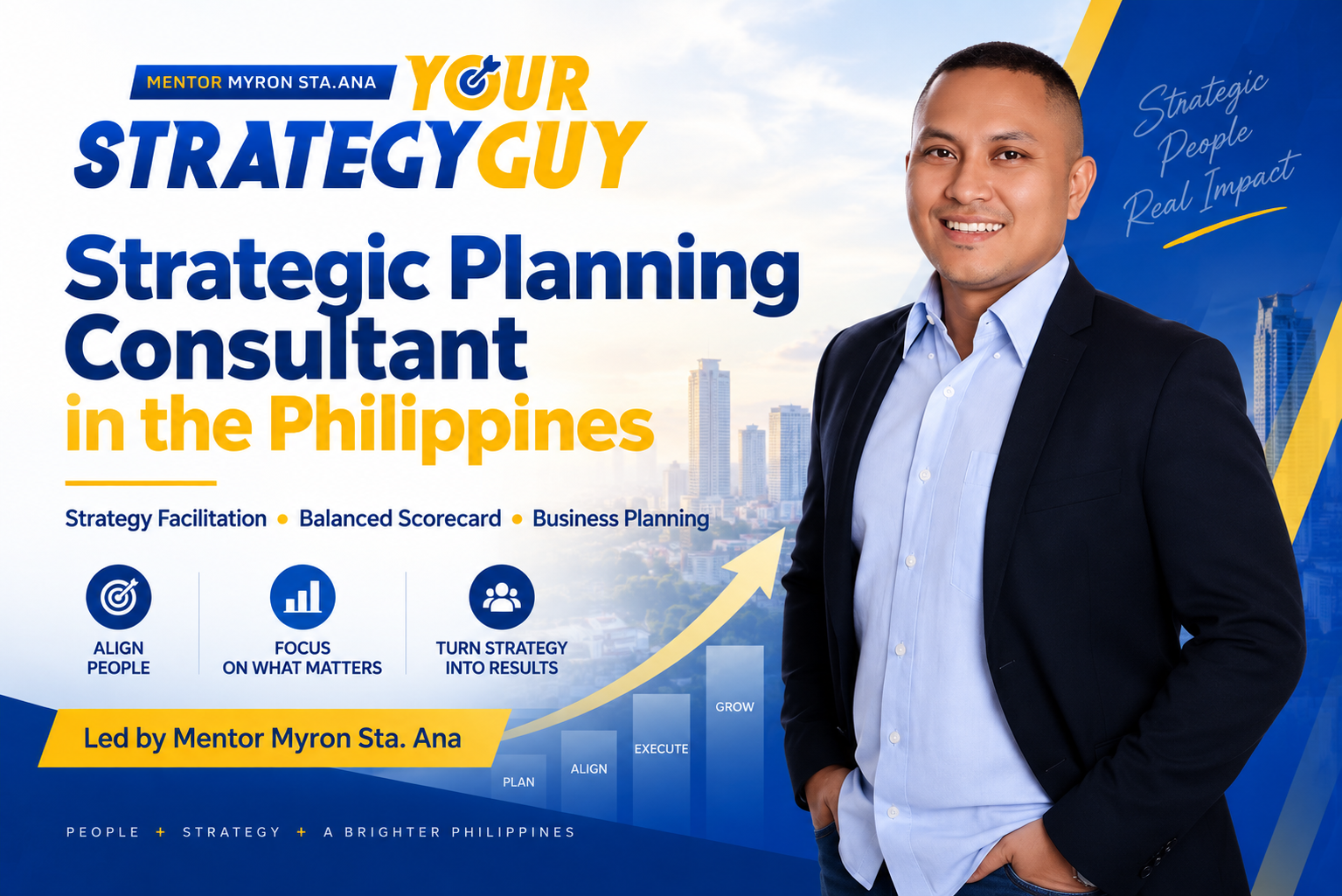
Strategic Planning Consultant in the Philippines
Strategic Planning Consultancy for Companies, Corporations, Government Organizations, and Leadership Teams in the Philippines
Organizations need more than a strategic planning workshop.
They need a disciplined process for understanding their current reality, making the right strategic choices, aligning leadership, translating priorities into measurable objectives, and ensuring that strategy can move from planning to execution.
Your Strategy Guy, led by Mentor Myron Sta. Ana, provides Strategic Planning Consultancy in the Philippines for private companies, corporations, government institutions, associations, cooperatives, and other organizations that need professional assistance in developing, strengthening, reviewing, or executing their strategic plans.
Since 2017, Mentor Myron Sta. Ana has served organizations in different industries and sectors as a Strategic Planning Consultant and Facilitator in the Philippines, helping leadership teams work through strategic analysis, organizational alignment, Strategy Map development, Balanced Scorecard formulation, KPI development, target setting, strategic initiatives, departmental cascading, tactical planning, and strategy execution.
The objective is not simply to produce another strategic plan.
The objective is to help organizations develop a strategy that is:
clear enough to communicate, focused enough to prioritize, measurable enough to manage, aligned enough to execute, and practical enough to guide leadership decisions after the planning workshop is over.
What Is a Strategic Planning Consultant?
A Strategic Planning Consultant helps an organization determine where it currently stands, where it intends to go, what strategic issues must be addressed, what choices need to be made, and how those choices can be translated into measurable organizational action.
Strategic planning consultancy may include work before, during, and after the formal planning sessions.
Depending on the client’s requirements, the consultancy may assist with:
- strategic planning diagnosis and design;
- executive and stakeholder consultation;
- review of the existing strategic plan;
- organizational performance review;
- Vision, Mission, and Values assessment;
- internal organizational analysis;
- SWOT Analysis;
- PESTLE Environmental Scanning;
- root-cause analysis;
- industry and competitor assessment;
- identification of strategic issues and priorities;
- strategic goal formulation;
- strategic objective development;
- Strategy Map development;
- Balanced Scorecard development;
- KPI and performance-measure formulation;
- target setting;
- strategic initiative development;
- departmental cascading;
- tactical planning;
- departmental action planning;
- strategic-plan documentation; and
- strategy review and execution mechanisms.
A professional Strategic Planning Consultant in the Philippines should therefore provide more than templates.
The consultant should help leadership improve the quality of the thinking, analysis, decisions, alignment, and management systems surrounding the strategy.
Strategic Planning Consultancy That Goes Beyond the Workshop
One of the most common misconceptions about strategic planning is that the entire process happens inside a one-day, two-day, or three-day workshop.
The planning proper is important.
But strong strategic planning may require significant work before and after the workshop.
A comprehensive engagement can therefore be structured into three major stages:
Pre-Strategic Planning
This stage establishes the foundation for informed strategic decision-making.
Activities may include:
- determining the planning objectives;
- clarifying the planning horizon;
- reviewing previous strategic plans;
- gathering organizational information;
- preparing strategic planning questionnaires;
- conducting leadership consultations;
- reviewing performance information;
- analyzing stakeholder concerns;
- gathering market or industry intelligence;
- preparing SWOT inputs;
- conducting environmental scanning;
- and identifying preliminary strategic issues.
Strategic Planning Proper
This is where the leadership team analyzes, discusses, challenges, prioritizes, decides, and aligns.
Depending on the engagement, the planning proper may cover:
- organizational situational analysis;
- Vision, Mission, and Values;
- strategic issues;
- strategic priorities;
- strategic goals;
- strategic objectives;
- Strategy Map;
- Balanced Scorecard;
- KPIs;
- performance targets;
- strategic initiatives;
- ownership;
- cross-functional alignment;
- and organizational action planning.
Post-Strategic Planning
A consultancy may continue after the workshop through:
- consolidation of outputs;
- strategic-plan documentation;
- refinement and validation;
- KPI finalization;
- departmental cascading;
- tactical planning;
- action-plan development;
- implementation guidance;
- business reviews;
- and strategy execution follow-through.
This approach helps transform strategic planning from an isolated event into a strategic management process.
Strategic Planning Consultant vs. Strategic Planning Facilitator
Organizations searching for a Strategic Planning Consultant in the Philippines may also encounter the term Strategic Planning Facilitator.
The two roles are related, but they are not exactly the same.
Strategic Planning Consultant
A Strategic Planning Consultant provides technical and advisory expertise.
This may include:
- diagnosing the organization’s planning requirements;
- recommending the planning framework;
- analyzing organizational information;
- challenging assumptions;
- designing the strategic planning process;
- developing Strategy Maps and Balanced Scorecards;
- guiding KPI and target development;
- reviewing proposed initiatives;
- supporting documentation; and
- advising leadership before and after the planning proper.
Strategic Planning Facilitator
A Strategic Planning Facilitator manages the group process through which leaders create the strategy.
Facilitation includes:
- guiding discussions;
- encouraging participation;
- asking strategic questions;
- managing competing viewpoints;
- challenging unclear thinking;
- preventing discussions from becoming overly operational;
- helping participants prioritize;
- facilitating consensus;
- managing cross-functional alignment; and
- converting discussion into decisions and outputs.
Many comprehensive strategic planning engagements require both consultancy and facilitation.
Your Strategy Guy can provide both roles depending on the organization’s needs.
Business Planning Consultant in the Philippines
Organizations sometimes search for a Business Planning Consultant in the Philippines when the actual requirement involves developing a company’s direction, priorities, targets, strategies, and execution plans.
Business planning and strategic planning overlap, but they are not always identical.
A business planning engagement may place greater emphasis on areas such as:
- business direction;
- market opportunities;
- customers;
- products or services;
- operating requirements;
- growth plans;
- commercial priorities;
- resources;
- financial considerations;
- and implementation.
Strategic planning typically takes a broader and longer-term view of the organization.
Where appropriate, a consultancy can integrate both perspectives so that long-term strategy is connected with practical business priorities.
Corporate Planning Consultant in the Philippines
A Corporate Planning Consultant in the Philippines assists leadership in strengthening organization-wide planning and performance-management systems.
This may include:
- corporate strategic direction;
- strategic priorities;
- organization-wide objectives;
- Strategy Maps;
- Balanced Scorecards;
- corporate KPIs;
- target setting;
- enterprise initiatives;
- departmental alignment;
- strategic cascading;
- annual tactical planning;
- and strategic performance reviews.
Corporate planning becomes particularly important when several departments, business units, branches, or functions need to contribute to one organizational strategy.
The objective is to prevent each department from operating as though it were pursuing an independent strategy.
Company Planning Consultant in the Philippines
The phrase Company Planning Consultant in the Philippines is also used by organizations looking for an external professional to help management plan the company’s future.
The actual requirement may involve:
- strategic planning;
- business planning;
- corporate planning;
- tactical planning;
- annual planning;
- performance management;
- organizational development; or
- a combination of these.
An effective consultancy begins by determining the actual management problem and expected outputs before recommending the process.
The organization should not be forced into a strategic planning framework simply because that happens to be the consultant’s preferred template.
The Strategic Planning Consultancy Process
While every engagement should be customized, a comprehensive strategic planning consultancy may follow the process below.
1. Clarify Why Strategic Planning Is Needed
A strategic planning engagement should begin by determining why the organization is planning.
Possible triggers include:
- expiration of the current strategic plan;
- a major change in leadership;
- rapid business growth;
- organizational restructuring;
- expansion;
- changing customer expectations;
- new competition;
- technology disruption;
- regulatory changes;
- poor strategic execution;
- disconnected departmental plans;
- outdated KPIs;
- or the absence of a formal long-term strategy.
The reason for planning influences the design of the entire engagement.
2. Determine the Strategic Planning Horizon
Organizations need to establish whether they are developing a:
- one-year plan;
- three-year plan;
- five-year strategic plan;
- mid-term strategic review;
- annual tactical plan;
- or another planning horizon.
Longer planning horizons generally require greater attention to:
- environmental change;
- market development;
- organizational capability;
- technology;
- people;
- investment;
- competitive positioning;
- and future organizational requirements.
3. Review the Previous Strategic Plan
Where an existing plan is available, the next strategy should not be developed without learning from the previous one.
Leadership should examine:
- targets that were achieved;
- targets that were missed;
- initiatives that succeeded;
- initiatives that did not work;
- activities that were never implemented;
- assumptions that changed;
- execution barriers;
- useful KPIs;
- weak KPIs;
- and lessons that should influence the next planning cycle.
Strategic planning should include organizational learning, not merely future brainstorming.
4. Assess the Current Organizational Situation
Organizations need a realistic understanding of their present state before defining their future.
Internal analysis may examine:
Financial and Resource Capability
How sustainable are the organization’s financial and other resources?
Customers and Stakeholders
How effectively is the organization creating value for the people or organizations it serves?
Internal Processes
Which processes are working well, and which processes limit performance?
Organizational Capability
Does the organization have the required people, competencies, leadership, technology, infrastructure, systems, structure, and culture?
Change Readiness
Is the organization capable of executing the changes required by the strategy?
This analysis provides the foundation for identifying meaningful strategic strengths and weaknesses.
5. Conduct Root-Cause Analysis
Strategic planning should not treat every visible problem as the actual problem.
For example:
High employee turnover may be caused by compensation, leadership, recruitment, career opportunities, workload, culture, or job design.
Customer dissatisfaction may be caused by product quality, communication, process delays, service standards, technology, or unclear accountability.
Poor productivity may be caused by skill gaps, outdated equipment, process design, technology, staffing, or management practices.
Techniques such as the Five Whys can help leadership move from symptoms toward underlying causes.
This matters because strategic initiatives should address what is producing the problem, not merely the visible result.
6. Conduct SWOT Analysis
SWOT remains a useful strategic planning tool when applied properly.
It organizes relevant findings into:
- Strengths
- Weaknesses
- Opportunities
- Threats
But SWOT should not become the strategic plan itself.
The more important task is to determine what strategic response should follow from the analysis.
For example:
How can strengths be maximized?
Which weaknesses must be corrected?
Which opportunities deserve investment?
Which threats need mitigation?
Which combinations create the most important strategic choices?
SWOT should produce strategic thinking—not simply four lists.
7. Perform PESTLE Environmental Scanning
A comprehensive external analysis may consider:
Political
Government priorities, political developments, public policy, and related factors.
Economic
Inflation, interest rates, economic growth, labor costs, investment conditions, and other economic developments.
Social
Demographic changes, workforce expectations, customer lifestyles, cultural trends, and societal developments.
Technological
Artificial intelligence, automation, digital transformation, emerging platforms, cybersecurity, and new technologies.
Legal
New laws, regulations, compliance requirements, and industry-specific legal developments.
Environmental
Climate risks, sustainability expectations, environmental regulation, natural hazards, and environmental changes.
The purpose of PESTLE is not merely to identify trends.
The more important question is:
What strategic implications do these developments have for the organization?
8. Identify Strategic Issues and Priorities
Strategic planning requires prioritization.
Organizations normally identify more problems and opportunities than they can realistically address simultaneously.
The planning process therefore needs to distinguish:
strategic issues
from
routine operational concerns.
Strategic issues usually have significant implications for:
- long-term growth;
- sustainability;
- competitiveness;
- customer or stakeholder value;
- organizational capability;
- risk;
- financial viability;
- or achievement of the organization’s desired future.
A strong strategic plan should contain a manageable number of priorities.
If everything is strategic, nothing is truly prioritized.
9. Establish Strategic Goals
Strategic goals describe the major organizational outcomes that leadership intends to accomplish.
These goals should emerge from:
- organizational direction;
- internal analysis;
- external analysis;
- strategic issues;
- opportunities;
- threats;
- and leadership choices.
Strategic goals should represent meaningful destinations rather than long lists of routine activities.
10. Formulate Strategic Objectives
Strategic objectives define how strategic goals will be achieved.
Strong objectives should be sufficiently observable and measurable to guide performance management.
A S.M.A.R.T.E.R. approach may be applied:
- Specific
- Measurable
- Achievable or Attainable
- Relevant
- Timely or Time-bound
- Evaluable or Evaluated
- Recorded or Reported
This helps move an organization from broad intentions to manageable commitments.
11. Develop the Strategy Map
For organizations using the Balanced Scorecard, strategic objectives can be organized into a Strategy Map.
A corporate Strategy Map commonly considers four perspectives:
Financial Perspective
What financial or resource outcomes are necessary to sustain the organization?
Customer or Stakeholder Perspective
What value must the organization create for customers or stakeholders?
Internal Process Perspective
Which internal processes must perform exceptionally well?
Organizational Capacity / Learning and Growth Perspective
What people, technology, systems, culture, leadership, and infrastructure are required to support the strategy?
The perspectives may be adapted for government organizations, nonprofits, associations, or organizations with different mandates.
12. Build the Balanced Scorecard
The Balanced Scorecard translates strategic objectives into measurable performance.
A typical structure connects:
Strategic Objective → Performance Measure / KPI → Target
This creates a practical bridge between:
strategy formulation
and
strategy management.
The Balanced Scorecard should therefore be treated as more than a table of KPIs.
It should reflect the organization’s strategic logic.
13. Develop Strategic KPIs
A Key Performance Indicator should help management answer:
Is this strategic objective progressing?
Not everything that can be counted should become a strategic KPI.
Activity measures can be useful, but they should not automatically be confused with strategic results.
For example:
Number of training programs conducted
measures activity.
A measure related to improved competency or performance is more closely connected with the intended result.
Strong KPI development helps organizations measure what matters, rather than merely what is convenient to report.
14. Set Strategic Targets
Targets define the expected level of performance.
Target setting should consider:
- baseline information;
- historical performance;
- benchmarks;
- strategic ambition;
- available resources;
- organizational capability;
- environmental conditions;
- and realistic implementation timelines.
Targets should challenge the organization while remaining credible enough to guide management decisions.
15. Develop Strategic Initiatives
Strategic initiatives are the major interventions intended to move strategic measures toward their targets.
Examples may include:
- market-development programs;
- customer-experience initiatives;
- process redesign;
- digital transformation;
- organizational restructuring;
- leadership-development programs;
- technology modernization;
- product development;
- capability-building;
- business expansion;
- or cost and productivity programs.
Every strategic initiative should be tested against an important question:
Which strategic objective and performance measure is this initiative expected to influence?
If there is no clear connection, it may not belong in the strategic plan.
16. Establish Ownership and Cross-Functional Alignment
Organizational strategy cannot be executed by a single department.
Different objectives may require collaboration among:
- Sales;
- Marketing;
- Operations;
- Finance;
- Human Resources;
- Information Technology;
- Supply Chain;
- Production;
- Administration;
- Quality;
- and other business units.
Strategic planning should therefore identify:
- objective owners;
- initiative owners;
- enabling departments;
- dependencies;
- accountability;
- and coordination requirements.
Cross-functional alignment reduces the risk of different departments unknowingly working against one another.
17. Cascade the Strategic Plan
Once the organizational strategy has been established, it can be translated into appropriate departmental responsibilities.
Cascading may include:
- departmental objectives;
- Key Result Areas;
- departmental KPIs;
- annual initiatives;
- action plans;
- timelines;
- accountabilities;
- and resource requirements.
This gives employees and managers a clearer line of sight between their work and the organization’s strategic direction.
18. Develop Tactical and Action Plans
Strategic planning explains the longer-term direction.
Tactical planning translates that strategy into nearer-term priorities.
Action planning provides even greater implementation detail.
A properly connected hierarchy may look like:
Strategic Goal
↓
Strategic Objective
↓
KPI
↓
Target
↓
Strategic Initiative
↓
Departmental Plan
↓
Action Steps
↓
Ownership and Timeline
This helps prevent strategy from remaining at the executive level.
19. Document the Strategic Plan
Strategic planning outputs should eventually be consolidated into a usable reference document.
Depending on the engagement, the strategic-plan documentation may contain:
- Vision, Mission, and Values;
- organizational analysis;
- strategic issues;
- strategic goals;
- strategic objectives;
- Strategy Map;
- Balanced Scorecard;
- KPIs;
- targets;
- strategic initiatives;
- departmental responsibilities;
- and implementation guidance.
The purpose is not to create the longest strategic plan possible.
The document should be useful enough for leaders to manage from it.
20. Establish Strategy Execution and Review
Strategic management continues after strategic planning.
Management should periodically review:
- KPI performance;
- progress against targets;
- initiative implementation;
- barriers to execution;
- changes in assumptions;
- emerging opportunities;
- new risks;
- and required corrective actions.
This creates a continuous management cycle:
Plan → Execute → Measure → Review → Learn → Adjust
A strategic plan should therefore be treated as a living management framework, not simply a document produced every several years.
Balanced Scorecard Consultancy in the Philippines
The Balanced Scorecard is one of the principal frameworks that may be used in Your Strategy Guy’s strategic planning consultancy engagements.
It is particularly useful when organizations need to connect:
Strategy → Objectives → Measures → Targets → Initiatives
The framework encourages management to examine performance from more than a purely financial perspective.
Depending on the organization, Balanced Scorecard perspectives can include:
- Financial
- Customer / Stakeholder
- Internal Processes
- Organizational Capacity / Learning and Growth
- Social Impact or other mission-related perspectives
The methodology is adapted according to the organization’s context rather than applied mechanically.
Strategy Map Development
A Strategy Map helps leadership visualize how strategic objectives work together.
For example:
Organizational capability can improve internal processes.
Better internal processes can improve customer outcomes.
Improved customer outcomes can contribute to stronger financial or stakeholder results.
A properly designed Strategy Map therefore tells the strategic story of the organization.
It is not merely a collection of unrelated objectives arranged on one page.
KPI Development and Performance Management
Strategic planning and performance management should reinforce one another.
A strategy without measurement can be difficult to manage.
Measurement without strategy can result in organizations tracking indicators that have little relationship with what leadership is actually trying to accomplish.
Your Strategy Guy’s strategic planning consultancy can therefore incorporate:
- Key Result Area development;
- KPI formulation;
- leading and lagging indicators;
- baseline determination;
- target setting;
- organizational scorecards;
- departmental scorecards;
- and performance-review mechanisms.
The objective is to strengthen the link between what the organization says is strategically important and what management actually monitors.
Strategic Planning for Private Companies in the Philippines
Private companies frequently require strategic planning assistance when dealing with:
- business growth;
- market expansion;
- competitive pressure;
- customer expectations;
- profitability;
- technology;
- organizational maturity;
- succession;
- restructuring;
- people capability;
- digital transformation;
- or execution challenges.
A private-sector strategic plan may therefore need to integrate:
financial performance, customer value, operations, organizational capability, people, technology, and competitive positioning.
Strategic Planning for Government Organizations in the Philippines
Government strategic planning requires careful consideration of:
- legal mandate;
- public value;
- stakeholder outcomes;
- government policies;
- performance-management requirements;
- governance;
- resource stewardship;
- organizational capability;
- and social impact.
The strategic planning methodology must therefore be adapted to the institution’s mandate and accountability environment.
A government strategy should not simply imitate a private corporation’s strategy.
Strategic Planning for Associations, Cooperatives, and Nonprofit Organizations
Associations, cooperatives, nonprofit institutions, and professional organizations have their own strategic-management considerations.
Success may involve:
- membership value;
- stakeholder engagement;
- service quality;
- financial sustainability;
- governance;
- institutional capability;
- advocacy;
- member participation;
- and long-term relevance.
Their strategic plans should therefore reflect the reason the organization exists.
Filipino Strategic Planning Consultant With Cross-Sector Experience
Mentor Myron Sta. Ana has been professionally involved in strategic planning consultancy and facilitation since 2017.
His strategic planning engagements have included organizations from sectors such as:
- manufacturing;
- financial and business information services;
- engineering;
- technology;
- construction-related businesses;
- government institutions;
- cooperatives;
- professional services;
- and other corporate environments.
This cross-sector experience provides exposure to different strategic challenges while maintaining an important consulting principle:
Every organization must be understood on its own terms.
Previous experience provides frameworks and perspective.
It should never become an excuse to assume that the next client’s issues are identical to those of a previous organization.
Strategic Planning Expertise With a Strong Execution Orientation
Your Strategy Guy’s approach is built around several strategic planning principles.
Strategic Thinking Before Templates
Templates provide structure.
Leadership judgment creates strategy.
Evidence Before Assumptions
Where reliable information is available, strategic discussions should be informed by data rather than unsupported impressions.
Root Causes Before Solutions
Visible organizational problems should be investigated before expensive strategic initiatives are developed.
Strategic Priorities Before Long Lists
Organizations cannot treat every issue as equally strategic.
Strategy requires choices.
Objectives Before KPIs
Measures should reflect strategic objectives—not determine them.
Measures Before Claims of Success
Leadership needs credible evidence for determining whether the strategy is working.
Ownership Before Accountability
Strategic responsibility should be clear before performance is reviewed.
Alignment Before Execution
Departments cannot successfully execute an organization-wide strategy if their objectives conflict.
Execution After Planning
A completed planning workshop is the beginning of strategic management—not the end.
Strategic Planning Consultancy, Facilitation, Training, Speaking, and Coaching
Your Strategy Guy can support organizations through different forms of strategic planning intervention.
Strategic Planning Consultancy
For organizations requiring diagnosis, frameworks, strategic guidance, analysis, documentation, Balanced Scorecard development, KPI development, or end-to-end planning assistance.
Strategic Planning Facilitation
For leadership teams requiring an independent facilitator to guide the actual strategic planning discussions and decision-making process.
Strategic Planning Training
For leaders and managers who need to understand strategic thinking, SWOT, PESTLE, Strategy Maps, Balanced Scorecards, KPIs, strategic initiatives, or strategy execution.
Strategic Planning Speaking
For conferences, management meetings, leadership retreats, and organizational events requiring an engaging strategic-management learning session.
Strategic Planning Coaching
For executives, corporate planning leaders, or management teams needing continuing support in strategic decision-making, prioritization, review, and execution.
The appropriate combination depends on the organization’s situation.
Who Can Benefit From Strategic Planning Consultancy?
The service is particularly relevant to:
- Business Owners
- Boards of Directors
- Presidents and CEOs
- C-Level Executives
- Corporate Planning Heads
- Strategy Officers
- Human Resources Heads
- Organizational Development Heads
- Operations Leaders
- Finance Leaders
- Business Unit Heads
- Government Executives
- Association Leaders
- Cooperative Officers
- Management Committees
- Executive Committees
Strategic planning succeeds when the people responsible for making and executing significant organizational decisions are actively involved.
What to Look for in a Strategic Planning Consultant in the Philippines
Organizations comparing strategic planning consultants should evaluate more than presentation skills.
Important questions include:
- How will the consultant understand the organization’s situation?
- What pre-work will be required?
- What information must management prepare?
- How will previous strategic performance be reviewed?
- How will strategic issues be distinguished from operational problems?
- What planning framework will be used?
- Why is that framework appropriate?
- How will SWOT and environmental analysis become actual strategy?
- How will strategic objectives be formulated?
- How will KPIs and targets be established?
- How will departmental initiatives be aligned?
- How will leadership disagreements be facilitated?
- What happens after the planning workshop?
- What documentation will be produced?
- How will strategy eventually connect with execution?
A strategic planning consultant should help the organization think and decide more effectively, not merely complete worksheets.
Frequently Asked Questions About Strategic Planning Consultants in the Philippines
What does a Strategic Planning Consultant in the Philippines do?
A Strategic Planning Consultant helps an organization understand its current position, identify strategic issues, determine future direction, formulate strategic goals and objectives, develop measurement systems, identify strategic initiatives, establish ownership, and create mechanisms for execution and review.
What is a Filipino Strategic Planning Consultant?
A Filipino Strategic Planning Consultant is a Filipino strategic management professional who provides consultancy services to organizations requiring assistance in strategy formulation, strategic planning, performance measurement, alignment, and execution.
For organizations operating in the Philippines, familiarity with local business conditions, organizational culture, labor realities, government environment, and management practices can complement established international strategic-management frameworks.
What does a Business Planning Consultant in the Philippines do?
A Business Planning Consultant in the Philippines helps organizations develop or strengthen plans involving business direction, markets, customers, priorities, strategies, resources, performance expectations, and implementation.
Business planning may overlap with strategic planning depending on the organization’s requirements.
What does a Corporate Planning Consultant in the Philippines do?
A Corporate Planning Consultant in the Philippines helps organizations strengthen enterprise-level strategic planning, performance measurement, Strategy Maps, Balanced Scorecards, KPIs, targets, initiatives, departmental alignment, and strategic review systems.
What does a Company Planning Consultant in the Philippines do?
A Company Planning Consultant assists management in organizing and developing the company’s future direction and implementation plans.
Depending on the situation, the service may involve strategic planning, corporate planning, business planning, tactical planning, or a customized combination.
What is the difference between a Strategic Planning Consultant and Strategic Planning Facilitator?
A consultant provides strategic-management expertise, frameworks, analysis, and advisory guidance.
A facilitator manages the group process through which leadership discusses issues, challenges assumptions, makes decisions, and reaches alignment.
One professional can perform both roles when the engagement requires it.
How long does strategic planning take?
There is no universal duration.
The planning proper may require one day, two days, three days, five days, or another format depending on:
- organization size;
- complexity;
- planning horizon;
- participant readiness;
- amount of pre-work;
- strategic issues;
- and required outputs.
A comprehensive consultancy may also include substantial work before and after the formal planning sessions.
Does strategic planning always require the Balanced Scorecard?
No.
The Balanced Scorecard is highly useful when an organization needs to translate strategy into measurable objectives, KPIs, targets, and initiatives.
However, the framework should be selected according to the organization’s needs rather than forced into every engagement.
Can the consultancy develop a Strategy Map?
Yes.
Strategy Map development can form part of the strategic planning engagement, particularly when the organization wants to clarify the cause-and-effect relationships among strategic objectives.
Can the consultancy help develop KPIs?
Yes.
KPI development can be incorporated into strategic planning so that performance measures are directly connected with strategic objectives.
Can the strategic plan be cascaded to departments?
Yes.
The organizational strategy can be translated into departmental objectives, KRAs, KPIs, initiatives, responsibilities, and action plans where appropriate.
Can Your Strategy Guy facilitate only the workshop?
Yes.
Some organizations have already completed sufficient pre-work and analysis and need mainly an independent Strategic Planning Facilitator in the Philippines.
Other organizations require a more comprehensive consultancy.
The engagement should match the need.
From Strategic Planning to Strategic Management
A strategic planning engagement should ultimately help leadership connect:
Where the organization is today
to
where the organization intends to go
and then connect that direction with:
strategic goals, measurable objectives, KPIs, targets, initiatives, departmental ownership, execution, and review.
That progression can be summarized as:
Organizational Reality
↓
Strategic Analysis
↓
Strategic Issues
↓
Strategic Choices
↓
Strategic Goals
↓
Strategic Objectives
↓
Strategy Map
↓
Balanced Scorecard
↓
KPIs
↓
Targets
↓
Strategic Initiatives
↓
Departmental Cascading
↓
Execution
↓
Performance Review
↓
Strategic Learning and Adjustment
That is the difference between merely having a strategic plan and developing a system for strategic management.
Looking for a Strategic Planning Consultant in the Philippines?
Organizations preparing for a new strategic planning cycle, developing their first formal strategy, reviewing an existing plan, creating a Balanced Scorecard, establishing corporate KPIs, aligning departments, or improving strategy execution can engage Mentor Myron Sta. Ana – Your Strategy Guy for customized strategic planning consultancy and facilitation.
The service can be designed for organizations searching for a:
Strategic Planning Consultant in the Philippines
Business Planning Consultant in the Philippines
Company Planning Consultant in the Philippines
Corporate Planning Consultant in the Philippines
Filipino Strategic Planning Consultant
Filipino Business Planning Consultant
Filipino Company Planning Consultant
Filipino Corporate Planning Consultant
The terminology may differ.
The management objective remains the same:
Develop a clear direction, align the organization around it, establish meaningful measures of progress, and translate strategy into execution.
Mentor Myron Sta. Ana – Your Strategy Guy
Strategic Planning Consultancy • Strategic Planning Facilitation • Balanced Scorecard • Strategy Map Development • KPI Development • Strategic Cascading • Tactical Planning • Strategy Execution
Clearer Strategy. Stronger Alignment. Measurable Execution.
Get in touch today at +639958462495
or email me at iam@yourstrategyguy.com
Start building your strategy today—let’s turn your vision into a clear, actionable plan.