
Every strategic plan is built on assumptions.
Leaders may assume that customer demand will continue growing.
They may assume that the organization can recruit the people it needs.
They may assume that employees will adopt a new system, departments will collaborate, suppliers will remain reliable, financing will be available, or customers will accept a new product.
Some of these assumptions may be supported by evidence.
Others may be informed opinions.
A few may be little more than optimism presented as certainty.
The problem is not that strategic plans contain assumptions. Every decision about the future requires leaders to make judgments about conditions that have not happened yet.
The real problem is that many organizations never make those assumptions visible.
They discuss strategic goals, targets, projects, budgets, and Key Performance Indicators. But they rarely ask:
What must be true for this strategy to succeed?
That question is the foundation of a Strategic Assumptions Audit.
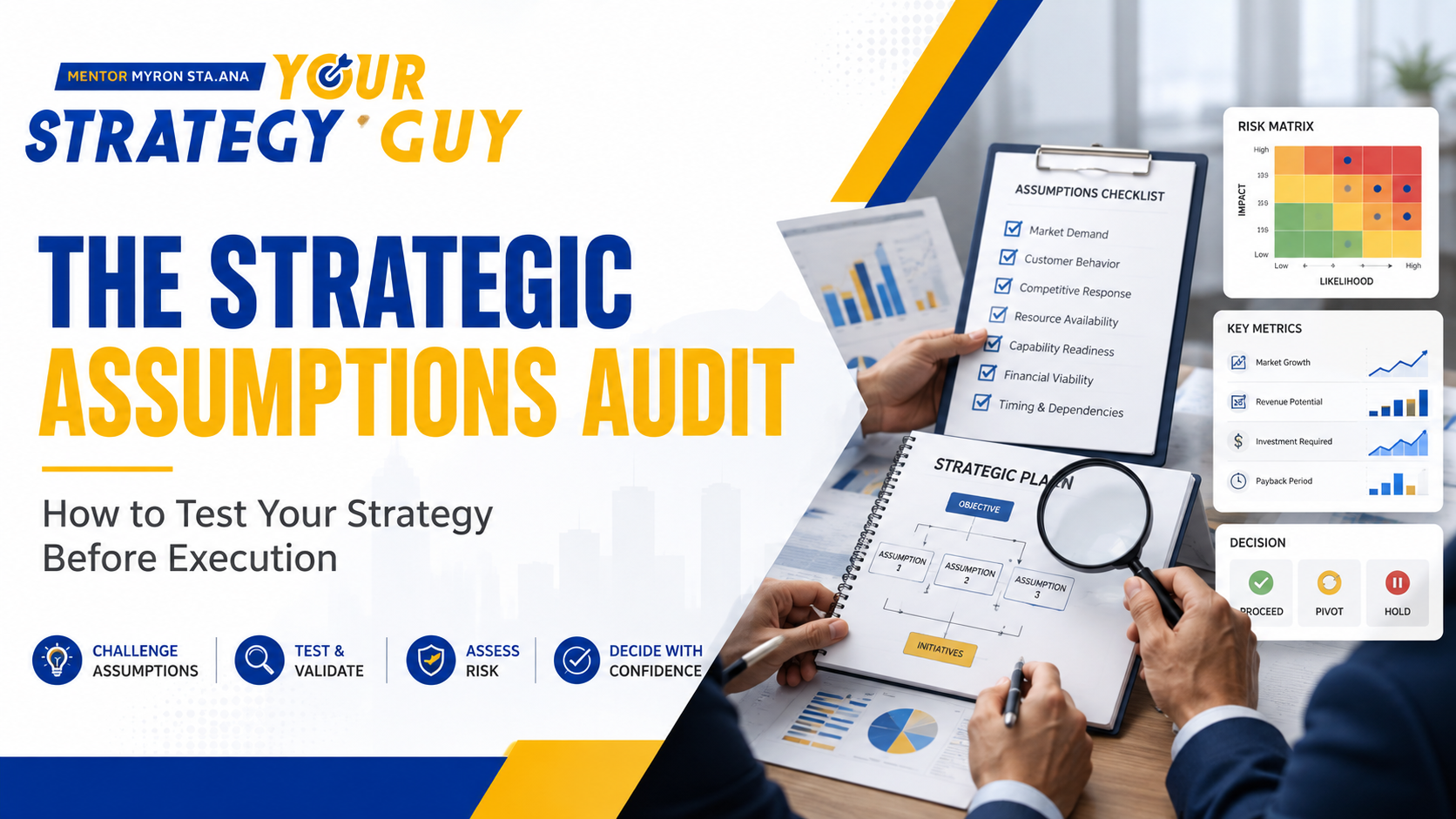
A Strategic Assumptions Audit is a structured process for identifying, testing, prioritizing, and monitoring the beliefs underneath a strategic plan.
It helps leaders distinguish what they know from what they believe—and what they merely hope will happen.
For business owners, C-level executives, planning leaders, Human Resources leaders, and Learning and Development professionals, this process can prevent an organization from executing a strategy built on outdated, weak, or untested beliefs.
What Is a Strategic Assumption?
A strategic assumption is a belief about the organization, its customers, its capabilities, or its environment that must remain sufficiently true for a strategic decision to produce the expected result.
Consider the following strategic decision:
Expand into a new geographic market within the next planning period.
That decision may depend on several assumptions:
- Enough customers in the market need the company’s offer.
- Those customers are willing and able to pay the proposed price.
- The company can differentiate itself from existing competitors.
- The organization can recruit or deploy capable employees.
- Operations can deliver the required quality and volume.
- The supply chain can support the expansion.
- Regulatory requirements can be met.
- The organization has enough capital and management attention.
- The brand can earn customer trust within a reasonable period.
The expansion strategy may look attractive on a presentation slide. However, its viability depends on whether these assumptions are accurate.
An organization that does not examine them may discover the truth only after money has been spent, people have been hired, facilities have been secured, and commitments have been made.
The Difference Between Facts, Assumptions, and Hopes
Strategic discussions often mix facts, assumptions, and hopes without distinguishing among them.
Facts
Facts are supported by reliable and current evidence.
Example:
Customer complaints involving delivery delays increased during the most recent review period.
This can be verified through records.
Assumptions
Assumptions are beliefs about what is likely to be true but still require validation.
Example:
Customers will remain loyal if delivery reliability improves.
This may be reasonable, but it should be tested through customer data, interviews, feedback, or behavioral evidence.
Hopes
Hopes express what leaders want to happen without sufficient evidence that it will.
Example:
Customers will eventually understand the price increase.
That may happen, but the statement does not yet explain why customers would accept it or what evidence supports the belief.
Strategic thinking requires leaders to avoid presenting assumptions and hopes as if they were established facts.
A productive planning conversation should allow participants to say:
- “We know this.”
- “We believe this.”
- “We still need to test this.”
- “We do not have enough information.”
- “This is currently an expectation, not evidence.”
That level of honesty strengthens decision-making.
Why Untested Assumptions Put Strategic Plans at Risk
A strategy may fail even when the goals are clear, the KPIs are measurable, and the action plans are complete.
The underlying assumptions may simply be wrong.
Market assumptions may be wrong
Leaders may overestimate:
- Customer demand
- Market growth
- Willingness to pay
- Brand acceptance
- Customer loyalty
- The attractiveness of a new offer
Operational assumptions may be wrong
Management may assume that existing systems, facilities, suppliers, and processes can support a growth target without examining actual capacity.
People assumptions may be wrong
The plan may depend on managers, employees, or future hires possessing capabilities that have not yet been developed.
Financial assumptions may be wrong
Expected revenue, costs, margins, cash requirements, or investment returns may be based on conditions that later change.
Execution assumptions may be wrong
Leadership may assume that departments will cooperate, employees will accept the change, project owners will follow through, and decisions will be made quickly.
A technically complete strategic plan cannot compensate for weak assumptions.
The document may be detailed.
The targets may be ambitious.
The strategy may still be fragile.
Six Categories of Strategic Assumptions
A practical Strategic Assumptions Audit should examine at least six categories.
1. Customer and Market Assumptions
These assumptions concern customers, demand, purchasing behavior, and the value proposition.
Questions include:
- Which customer problem are we solving?
- How strong is the demand?
- What evidence shows that customers value the solution?
- Will customers pay the proposed price?
- What factors influence purchasing decisions?
- How might customer expectations change?
- Why would customers choose us instead of another provider?
- Which customer segments are most attractive?
- What could cause customers to leave?
A strategic plan should not describe the market only from the organization’s perspective.
It should reflect what customers actually experience, need, value, reject, and choose.
2. Competitive Assumptions
These assumptions concern competitors, substitutes, differentiation, and industry behavior.
Questions include:
- Who are our actual competitors?
- What alternatives can customers choose?
- What are competitors likely to do in response to our strategy?
- Is our claimed advantage meaningful to customers?
- How easily can competitors imitate our offer?
- Are new competitors likely to enter?
- Which industry practices are changing?
- What would make our current advantage less valuable?
A strategy is not executed in an empty environment.
Competitors make decisions too.
They may lower prices, improve service, hire key people, adopt new technology, imitate successful offers, or form strategic partnerships.
Strategic planning must consider both the organization’s desired action and the likely reactions of other market participants.
3. Operational and Capability Assumptions
These assumptions concern whether the organization can deliver what the strategy requires.
Questions include:
- Do we have enough operational capacity?
- Can our current processes support the expected growth?
- Are our systems reliable and scalable?
- Can suppliers meet future requirements?
- Do we have the necessary technical knowledge?
- Where are the likely bottlenecks?
- What quality risks may emerge?
- Which processes must be redesigned?
- What must be automated, standardized, or improved?
A company may be capable of selling more than it can reliably deliver.
Growth can expose weaknesses that were less visible at a smaller scale.
A responsible strategy therefore examines the organization’s ability to fulfil the promises created by its commercial goals.
4. Workforce and Leadership Assumptions
These assumptions concern people, competencies, leadership readiness, culture, and behavior.
Questions include:
- Which roles are critical to the strategy?
- Do the people occupying those roles have the required capabilities?
- Can we recruit the talent we need?
- How long will capability development take?
- Are leaders prepared to manage the required change?
- Will managers cooperate across departments?
- What behaviors must change?
- What resistance should we expect?
- Does the culture support accountability, innovation, collaboration, and learning?
- What happens if key people leave?
This category is especially important for Human Resources and Learning and Development leaders.
A strategic goal may appear to be about growth, technology, customer experience, or efficiency. But its implementation may depend on leadership, competencies, workforce capacity, and behavior.
HR and L&D should therefore help test the people-related assumptions behind the strategy—not merely design training after the plan has been approved.
5. Financial and Resource Assumptions
These assumptions concern funding, affordability, profitability, cash flow, cost, and resource availability.
Questions include:
- What investment will the strategy require?
- When will financial benefits begin?
- What happens if costs exceed expectations?
- Can the organization sustain the strategy before returns are realized?
- Which resources are already committed elsewhere?
- What trade-offs must be made?
- Which initiatives should receive priority?
- What level of underperformance can the organization absorb?
- What conditions would require the strategy to be revised or stopped?
A strategic initiative may appear profitable over several years but still create short-term pressure that the organization cannot sustain.
Financial viability should therefore include timing, uncertainty, liquidity, capacity, and opportunity cost—not only projected revenue.
6. External Environment Assumptions
These assumptions concern factors outside the organization’s direct control.
They may include:
- Government policies
- Economic conditions
- Interest or exchange rates
- Labor-market conditions
- Technology developments
- Regulations
- Social trends
- Infrastructure
- Environmental risks
- Supply-chain conditions
- Industry standards
PESTLE analysis can help identify these external influences.
However, identifying a factor is not enough.
The planning team should explain what it assumes will happen and how that assumption affects the strategy.
For example:
Weak statement:
Technology is changing quickly.
Stronger strategic assumption:
The technology currently selected will remain suitable for the expected operational requirements during the initial implementation period.
The stronger statement can be investigated, monitored, and challenged.
The Strategic Assumptions Audit Process
The following process can be used during a strategic planning workshop, strategy review, Balanced Scorecard session, or executive planning meeting.
Step 1: Identify the Strategic Choice
Begin with a specific strategic decision or priority.
Examples include:
- Enter a new market
- Launch a new product
- Open additional locations
- Digitize a major process
- Improve customer retention
- Reduce operating cost
- Build a new service line
- Restructure the organization
- Develop a leadership pipeline
- Pursue a strategic partnership
Avoid auditing assumptions behind a vague aspiration such as “become more successful.”
The strategic choice must be clear enough to analyze.
Step 2: Complete the Sentence: “This Strategy Will Work If…”
Ask the planning team to complete this statement:
This strategy will work if…
Participants should identify the conditions that must be sufficiently true.
For example:
This strategy will work if priority customers value the new service enough to shift from their current provider.
This strategy will work if our operational capacity can increase without reducing quality.
This strategy will work if our managers can lead the change while maintaining current operations.
This strategy will work if the required talent can be recruited or developed within the implementation period.
These statements expose the beliefs underneath the plan.
Step 3: Classify Each Statement
Classify each item as:
- Confirmed fact
- Evidence-supported assumption
- Weakly supported assumption
- Unverified belief
- Hope or preference
This should not be treated as an exercise in proving that leadership is wrong.
Its purpose is to identify where more evidence or discussion is needed.
A weakly supported assumption may still be correct.
It simply represents a greater level of uncertainty.
Step 4: Rate Impact and Uncertainty
Assess each assumption using two questions:
- How serious would the effect be if this assumption were wrong?
- How uncertain are we that this assumption is true?
This produces four broad categories.
| Impact | Uncertainty | Required Response |
|---|---|---|
| Low | Low | Monitor routinely |
| High | Low | Protect and track |
| Low | High | Test when practical |
| High | High | Validate before major commitment |
The most dangerous assumptions are those with both high impact and high uncertainty.
These should receive priority attention before the organization commits significant money, time, reputation, or workforce capacity.
Step 5: Gather Evidence
The team should determine how each critical assumption can be tested.
Evidence may come from:
- Customer interviews
- Customer surveys
- Purchase behavior
- Sales history
- Pilot programs
- Market studies
- Competitor analysis
- Process-capacity data
- Financial modelling
- Employee assessments
- Supplier validation
- Technology demonstrations
- Regulatory consultation
- Scenario analysis
- Expert advice
The goal is not to remove all uncertainty.
That is impossible.
The goal is to reduce avoidable uncertainty before taking irreversible or expensive action.
Step 6: Design a Small Test
When possible, test a major assumption through a smaller and less costly intervention.
Instead of fully launching a service, the company might test it with selected customers.
Instead of implementing a system across the entire organization, it might begin with one process or business unit.
Instead of assuming that managers are ready, the organization might conduct a capability assessment.
Instead of immediately entering a new market, it might test demand through partnerships, limited distribution, or targeted campaigns.
A pilot does not guarantee success.
It provides evidence that can improve the quality of the larger decision.
Step 7: Establish Strategic Triggers
A strategic trigger is a condition that signals the need to review, modify, accelerate, postpone, or stop an initiative.
Examples include:
- Customer demand falls below an agreed threshold.
- Implementation cost exceeds the approved tolerance.
- A critical license is delayed beyond the required date.
- Recruitment for key roles remains unsuccessful.
- Technology adoption remains below the expected level.
- Supplier reliability deteriorates.
- Customer complaints reach an unacceptable level.
- A new competitor significantly changes the market.
- A project milestone is repeatedly missed.
Triggers prevent leaders from continuing with the original plan simply because they have already invested in it.
They create permission to adapt based on evidence.
Step 8: Assign an Assumption Owner
Critical assumptions should have accountable owners.
The owner is responsible for:
- Gathering relevant evidence
- Monitoring indicators
- Reporting changes
- Recommending a response
- Escalating major concerns
- Updating the planning team
The owner does not control the external condition.
The owner ensures that the organization does not ignore it.
Strategic Assumption Register Template
Organizations can document their assumptions using a simple register.
| Strategic Priority | Critical Assumption | Evidence Available | Impact if Wrong | Uncertainty | Validation Method | Owner | Trigger | Review Date |
| Market expansion | Target customers will accept the offer | Preliminary research | High | High | Customer pilot | Commercial Head | Low conversion | Quarterly |
| Digital transformation | Employees can adopt the new workflow | Limited assessment | High | Medium | User-readiness test | IT and HR | Low adoption | Monthly |
| Growth strategy | Operations can support higher demand | Capacity data | High | Medium | Process simulation | Operations Head | Service decline | Monthly |
The register should remain active during execution.
It should not be completed during the workshop and forgotten afterward.
How Assumptions Differ From Risks, Constraints, and Objectives
These concepts are related but not identical.
Assumption
Something believed to be true for planning purposes.
Customers will accept digital self-service.
Risk
An uncertain event that may negatively affect the strategy.
Customers may reject the new digital platform.
Constraint
A known limitation that restricts available choices.
The organization has a fixed implementation budget.
Objective
A result the organization intends to achieve.
Increase the percentage of transactions completed digitally.
Initiative
An organized action intended to achieve the objective.
Develop and implement a customer self-service portal.
Separating these concepts improves strategic clarity.
How to Connect Assumptions With the Balanced Scorecard
Strategic assumptions should not remain separate from the Balanced Scorecard.
They can be connected to its four perspectives.
Financial Perspective
Assumptions may concern:
- Revenue growth
- Cost reduction
- Investment requirements
- Profitability
- Cash availability
- Return timing
Customer Perspective
Assumptions may concern:
- Customer demand
- Satisfaction
- Loyalty
- Willingness to pay
- Brand trust
- Service expectations
Internal Process Perspective
Assumptions may concern:
- Process capability
- Quality
- Turnaround time
- Supplier performance
- Technology reliability
- Cross-functional coordination
Learning and Growth Perspective
Assumptions may concern:
- Employee competencies
- Leadership readiness
- Culture
- Workforce capacity
- Technology adoption
- Change acceptance
When an assumption is strategically important, the organization should identify an indicator that helps monitor whether it remains valid.
This makes the Balanced Scorecard more than a performance report.
It becomes an early-warning system for strategy.
A Hypothetical Example: Growth Without Readiness
Consider a Philippine company planning to expand its services to a new customer segment.
Its strategy assumes that:
- The segment has sufficient demand.
- The company’s offer is attractive.
- Sales employees can sell consultatively.
- Operations can handle more customized requirements.
- The company can maintain service quality.
- Existing systems can produce the necessary reports.
- Managers can coordinate cross-functional delivery.
Instead of approving the full expansion immediately, leadership conducts a Strategic Assumptions Audit.
The audit reveals that market interest appears promising, but internal readiness is uneven.
The company therefore decides to:
- Pilot the offer with a limited set of customers.
- Train selected account managers.
- Review process capacity.
- Define service standards.
- Improve coordination among Sales, Operations, Finance, and Customer Service.
- Monitor customer response and delivery performance.
- Review the assumptions before full expansion.
The strategy has not been abandoned.
It has been strengthened through evidence, staged commitment, and organizational preparation.
That is strategic thinking in action.
Questions Leaders Should Ask Before Approving a Strategic Plan
Before final approval, the leadership team should answer the following:
- What must be true for each major strategic priority to succeed?
- Which assumptions are supported by evidence?
- Which assumptions remain uncertain?
- Which assumption would cause the greatest damage if wrong?
- What evidence would change our decision?
- What can we test before making a major commitment?
- What early-warning indicators should we monitor?
- Who owns each critical assumption?
- When will assumptions be reviewed?
- Under what conditions will we modify, postpone, or stop the strategy?
These questions do not weaken confidence.
They create disciplined confidence.
The Role of a Strategic Planning Consultant in the Philippines
An external Strategic Planning Consultant in the Philippines can help leaders surface assumptions that may be difficult to challenge internally.
Executives and department heads are sometimes too familiar with the organization’s existing beliefs.
Certain assumptions may have been repeated for years:
- “Our customers will not accept that.”
- “Our people are not ready.”
- “This is how the industry works.”
- “We cannot compete there.”
- “The market will keep growing.”
- “That problem will resolve itself.”
A consultant can help separate evidence from organizational habit.
The consultant may support the organization by:
- Structuring the assumptions audit
- Asking neutral and challenging questions
- Identifying information gaps
- Facilitating scenario analysis
- Connecting assumptions to goals and KPIs
- Designing validation activities
- Establishing monitoring indicators
- Integrating findings into the strategic plan
The Role of a Strategic Planning Facilitator
A Strategic Planning Facilitator in the Philippines helps the leadership team discuss assumptions without turning the session into a contest of personalities.
The facilitator encourages participants to challenge ideas rather than attack people.
This is particularly useful when:
- Senior leaders hold different views.
- Departments interpret the market differently.
- Operational teams question ambitious growth targets.
- HR identifies workforce concerns.
- Finance raises affordability issues.
- Sales and Marketing present optimistic forecasts.
- Technology leaders identify implementation limitations.
The facilitator helps the group ask:
What evidence would help us resolve this disagreement?
That question moves the conversation from authority and opinion toward informed judgment.
The Role of Strategic Planning Training and Speaking
A Strategic Planning Trainer in the Philippines can build managers’ capability to identify assumptions, gather evidence, use scenario analysis, define strategic indicators, and connect uncertainty with action planning.
A Strategic Planning Speaker in the Philippines can also introduce leaders and employees to the importance of strategic thinking, adaptive execution, evidence-based decision-making, and organizational alignment.
Training and speaking engagements are especially useful when the organization wants to develop a common strategic language before a planning workshop or strategy review.
Frequently Asked Questions
What is a strategic assumption?
A strategic assumption is a belief about customers, competitors, internal capability, resources, people, or the external environment that must remain sufficiently true for a strategy to succeed.
Why should assumptions be tested?
Testing assumptions reduces the risk of committing major resources to a strategy based on weak, outdated, or unsupported beliefs.
Can all strategic uncertainty be eliminated?
No. Strategic decisions concern the future, so uncertainty will always exist. The objective is to identify the most important uncertainties, gather useful evidence, and prepare adaptive responses.
When should a Strategic Assumptions Audit be conducted?
It can be conducted during strategic planning, before approving major initiatives, during quarterly strategy reviews, or whenever important market or organizational conditions change.
Who should participate?
Participation may include business owners, executives, corporate planning leaders, Finance, Operations, Sales, Marketing, HR, L&D, IT, Risk, and other functions that understand the assumptions behind the strategy.
How often should assumptions be reviewed?
High-impact assumptions should be reviewed as frequently as the underlying conditions can meaningfully change. Some may require monthly monitoring, while others may be reviewed quarterly or during major strategy reviews.
Is assumption testing the same as being pessimistic?
No. It is disciplined strategic thinking. The purpose is not to reject ambitious strategies but to understand what they require and improve their probability of success.
Final Thoughts: Do Not Let Hidden Assumptions Manage Your Strategy
Every strategic plan contains beliefs about the future.
Some will prove accurate.
Others will change.
A few may have been wrong from the beginning.
The strongest leadership teams do not pretend that their assumptions are facts.
They identify them.
They test them.
They monitor them.
And when evidence changes, they adapt.
Strategic planning should not create false certainty.
It should help the organization make better decisions under uncertainty.
Before approving the next expansion, transformation, investment, restructuring, or growth initiative, ask one question:
What must be true for this strategy to work?
Then make sure the organization is prepared to discover—and act on—the answer.
Need Help Testing and Strengthening Your Strategy?
Your Strategy Guy helps organizations improve strategic thinking, validate strategic assumptions, align leaders, formulate measurable goals, develop Balanced Scorecards, cascade priorities, and build execution-ready action plans.
Organizations may engage us as their:
- Strategic Planning Consultant in the Philippines
- Strategic Planning Facilitator in the Philippines
- Strategic Planning Trainer in the Philippines
- Strategic Planning Speaker in the Philippines
- Balanced Scorecard Consultant
- Strategy Alignment Facilitator
- Strategy Execution Trainer
A strong strategy is not one that assumes everything will go according to plan.
A strong strategy knows what to monitor, what to test, and when to adapt.
Make assumptions visible. Test what matters. Execute with informed confidence.