

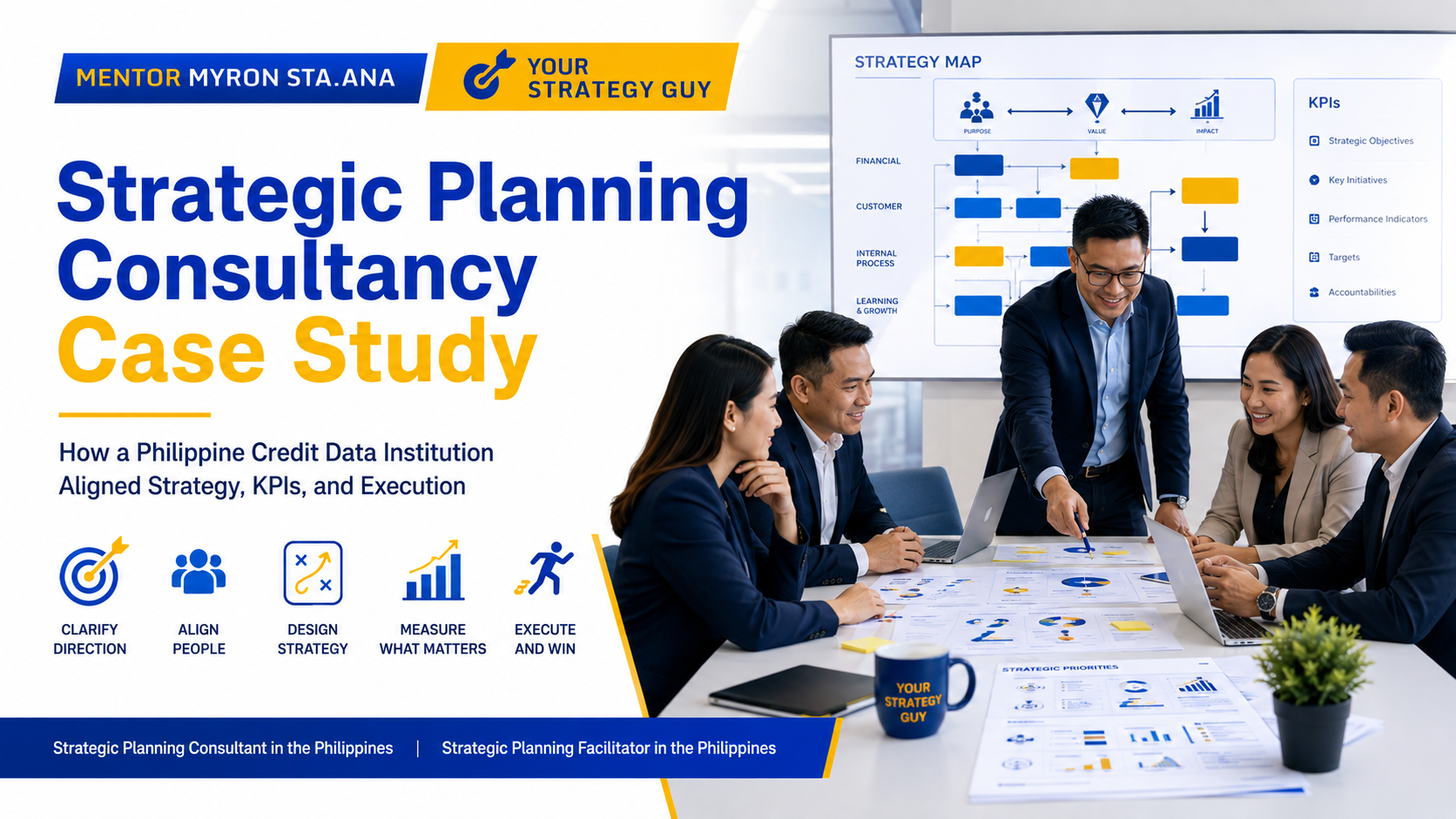
Strategic planning becomes more complex when an organization must balance public accountability, regulatory requirements, technology, stakeholder expectations, organizational capability, and long-term sustainability—not just financial performance.
This anonymized Strategic Planning Consultancy Case Study in the Philippines presents how a Philippine government-owned financial-technology institution was guided through a comprehensive multi-year strategic planning process designed to connect its legal mandate, organizational direction, performance requirements, strategic priorities, measurable objectives, and execution plans into one integrated strategic-management framework.
The engagement went beyond a conventional strategic planning workshop. It involved reviewing the organization’s mandate, Vision, Mission, and Core Values; assessing past performance and current organizational capacity; conducting SWOT analysis, PESTLE environmental scanning, and root-cause analysis; developing a Strategy Map; formulating strategic objectives; establishing performance measures and targets; identifying strategic initiatives; aligning departments; and preparing action plans for execution.
The planning process also incorporated the principles of the Balanced Scorecard and government performance-management frameworks, where strategic objectives are translated into measurable indicators, targets, and initiatives that help management track progress toward the organization’s long-term Vision.
One of the most important features of the consultancy was its emphasis on alignment and execution. Strategic goals were not left as broad aspirations. They were connected with specific objectives, measures, multi-year targets, organizational initiatives, departmental ownership, and action-planning responsibilities. The planning agenda required the organization to critique, agree on, and finalize the Strategy Map, measures, targets, initiatives, and related implementation commitments before moving into departmental action planning.
The engagement also used root cause analysis to help the organization distinguish visible performance issues from the deeper structural, capability, process, workforce, and organizational factors contributing to them. This helped ensure that strategic initiatives addressed more than symptoms and were better connected to the realities affecting execution.
This case study is particularly relevant to business owners, board members, chief executives, corporate planning leaders, Human Resources executives, government institutions, and organizations searching for a Strategic Planning Consultant in the Philippines, Strategic Planning Facilitator in the Philippines, Strategic Planning Coach in the Philippines, Balanced Scorecard Consultant, Strategy Map Consultant, or Strategic Planning Consultancy Service in the Philippines.
The embedded case study below demonstrates how strategic planning can be transformed from a one-time planning event into a structured management process that connects:
Mandate → Organizational Direction → Strategic Analysis → Strategy Map → Balanced Scorecard → KPIs and Measures → Targets → Strategic Initiatives → Departmental Action Plans → Execution and Monitoring
To protect client confidentiality, the organization’s name, acronym, logos, executives’ identities, exact dates, financial figures, budgets, revenues, operational volumes, customer statistics, staffing figures, proprietary targets, detailed systems information, and other identifying or sensitive data have been intentionally removed or generalized.
Read the embedded case study below to see how a Philippine organization used a disciplined strategic planning consultancy and facilitation process to convert long-term direction into a measurable, aligned, and execution-ready strategic management framework.
Check out our other Case Studies and Insights here.
To know more about Your Strategy Guy, visit his social media pages on Facebook, LinkedIn, and Instagram.