

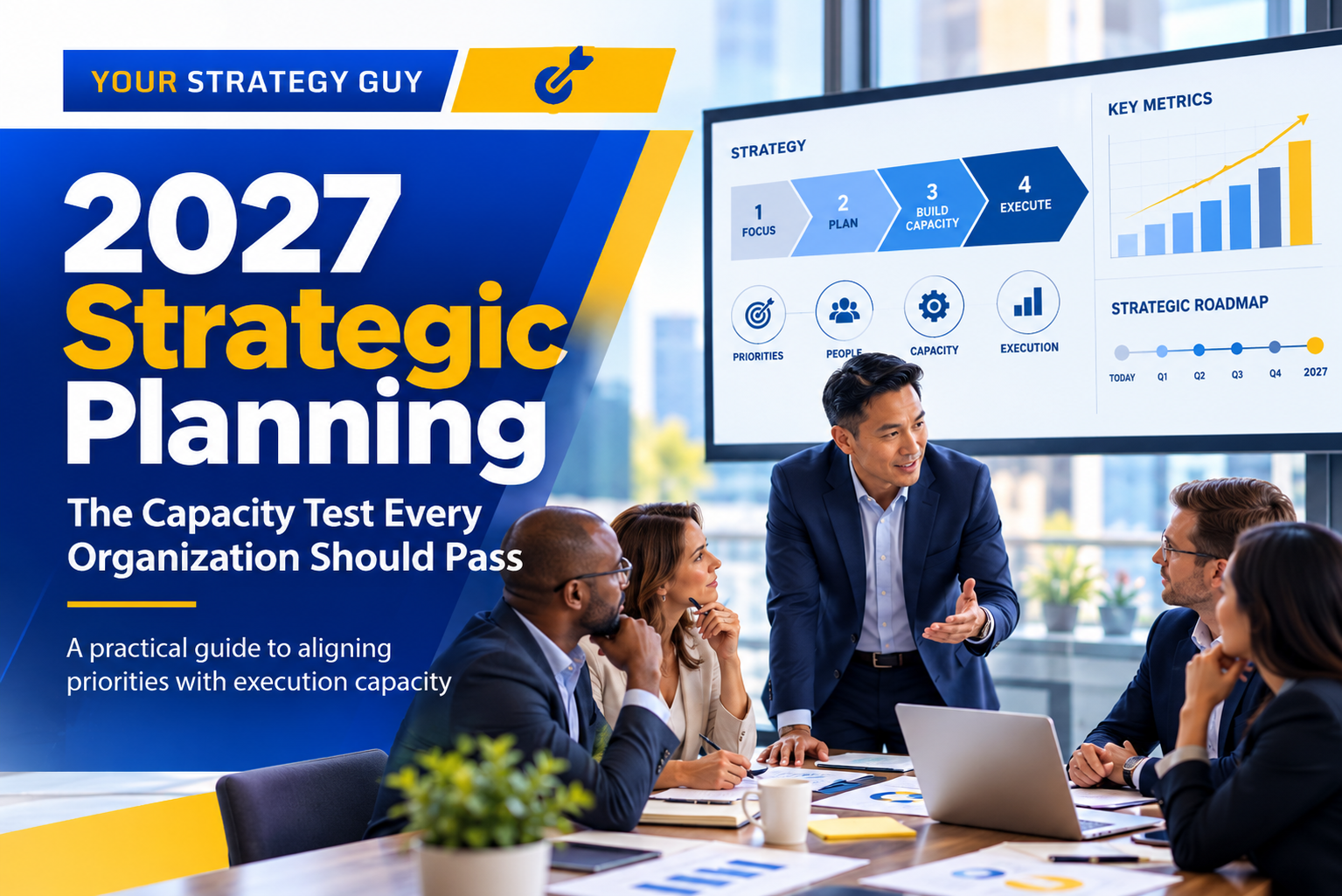
Why business owners, CEOs, corporate planning heads, and executive teams must match strategic priorities with actual execution capacity—not just ambition.
As 2026 approaches its final quarter, many Philippine organizations are beginning to prepare their strategic plans, annual business plans, operating priorities, and budgets for 2027.
Executive teams will gather to review performance, discuss market developments, identify opportunities, examine weaknesses, establish targets, and approve initiatives for the coming year.
The familiar questions will emerge:
- How much should the business grow?
- Which markets should it enter?
- What new products or services should it introduce?
- Which processes should be improved?
- What technology should be implemented?
- What new capabilities should employees develop?
These are necessary questions.
But one question deserves equal attention:
Does the organization actually have the capacity to execute everything it is about to approve?
An organization may develop an excellent strategic plan, establish ambitious KPIs, assign responsibilities, and commit to multiple transformation projects.
Yet if all those initiatives depend on the same limited number of managers, specialists, systems, and financial resources, the plan may already be overloaded before implementation begins.
That is why strategic planning for 2027 should include a Strategy Capacity Test.
The test is straightforward: determine whether the organization’s available execution capacity can realistically support its proposed strategic priorities, and make explicit choices when it cannot.
For business owners, founders, CEOs, corporate planning leaders, and management committees in the Philippines, this discipline can be the difference between an impressive planning document and a credible execution commitment.
The Hidden Problem: Organizations Approve More Strategy Than They Can Execute
Consider a hypothetical Philippine company preparing its 2027 annual plan.
The Sales Department proposes market expansion.
Marketing recommends a major brand development initiative.
Operations wants to redesign several processes.
Human Resources proposes a company-wide leadership development program.
Information Technology recommends implementing new digital systems.
Finance proposes stronger financial controls and reporting capabilities.
Each proposal may be valid.
Each department can present reasonable justifications.
Each initiative may support the company’s long-term objectives.
However, the difficulty appears when the plans are combined.
The market expansion depends on additional sales capability, marketing support, operational readiness, and system integration.
The process improvement initiative requires the participation of managers who are also responsible for daily operations.
The digital transformation program requires input from virtually every department.
The leadership development initiative needs the participation of the same managers who are expected to oversee those projects.
Meanwhile, the business must continue serving customers, fulfilling orders, managing employees, collecting receivables, meeting regulatory requirements, and delivering day-to-day results.
Individually, the initiatives seem achievable.
Collectively, they may exceed the organization’s capacity.
A strategic plan can be logically aligned and financially attractive while still being operationally unrealistic.
This is why strategic planning should not end with prioritizing initiatives. Leadership must determine whether those priorities can actually be delivered together.
What Is a Strategy Capacity Test?
A Strategy Capacity Test is a structured assessment of whether an organization’s people, time, budget, systems, leadership attention, and operational capabilities are sufficient to implement its proposed strategic initiatives.
It connects three fundamental questions:
1. Strategic importance: What must the organization accomplish?
2. Resource requirements: What will accomplishing it actually require?
3. Execution feasibility: Can the organization realistically deliver those requirements within the proposed timeframe?
The test is not intended to discourage growth, innovation, or ambitious strategic goals.
Instead, it helps management distinguish between an ambitious but executable strategy and an ambitious strategy that depends on resources the organization has not secured.
An organization can stretch its capabilities. But it should understand the gap it is choosing to close.
Why Budget Approval Is Not the Same as Execution Readiness
One mistake in corporate planning is assuming that an initiative becomes feasible once management approves its budget.
Financial resources matter, but they are only one dimension of execution.
A company may have sufficient funds for a new enterprise system but lack the internal expertise to implement and integrate it.
It may be able to afford an expansion project but lack managers capable of overseeing additional operations.
It may approve a new customer experience program but have insufficient operational capacity to support the promises made to customers.
A practical strategic capacity assessment should therefore examine at least four areas.
| Capacity Dimension | Questions for Management |
|---|---|
| Financial capacity | Can the organization fund the initiative without compromising essential financial commitments? |
| People and skills capacity | Are the required employees, specialists, leaders, and competencies available? |
| Operational and systems capacity | Can existing processes, infrastructure, equipment, and technology support implementation? |
| Leadership and decision capacity | Can executives provide timely decisions, oversight, coordination, and problem resolution? |
An initiative can be fully funded and still fail one or more of these tests.
This is particularly important for small and medium-sized enterprises, founder-led companies, and growing Philippine organizations where a few key people carry several major responsibilities.
A Practical Example: When Three Good Projects Compete for the Same Team
Suppose a company has three important strategic initiatives for 2027.
The initiatives require support from the same IT implementation team.
For illustration, management estimates that the team can devote 24 person-days per month to strategic improvement projects after allowing for normal operational responsibilities.
The proposed initiatives require the following:
| Proposed Initiative | Estimated IT Effort Per Month | Strategic Purpose |
|---|---|---|
| Customer relationship management implementation | 14 person-days | Improve customer management and retention |
| Management analytics dashboard | 10 person-days | Strengthen data-driven decision-making |
| Workflow automation | 12 person-days | Improve operational efficiency |
| Total required | 36 person-days |
These are hypothetical figures for explaining the method—not performance data from an actual client.
The organization has only 24 person-days available for an estimated 36 person-days of work.
Its proposed monthly demand is 150% of the available implementation capacity.
The problem is not necessarily that the strategic priorities are wrong.
The problem is that their proposed timing is not credible.
Management has several choices.
It could implement the customer management system and analytics dashboard first, assuming other resource and dependency requirements are satisfied, then sequence workflow automation later.
It could obtain additional qualified implementation capacity.
It could narrow the scope of one or more projects.
Or it could revise the schedule and phase implementation across the year.
What management should not do is approve all three for simultaneous delivery while pretending the capacity constraint does not exist.
This simple example illustrates a broader strategic management principle:
A realistic strategic plan does not merely identify what the organization wants to accomplish. It also determines what the organization can responsibly commit to accomplishing.
Seven Steps for Testing Your 2027 Strategic Planning Priorities
A Strategy Capacity Test can be incorporated into strategic planning, corporate planning, annual business planning, or tactical planning.
Step 1: Start With the Strategic Outcomes, Not the Departmental Wish Lists
Before comparing projects, leadership must identify the strategic outcomes that matter most.
For organizations using the Balanced Scorecard, these outcomes should already be represented by strategic objectives across relevant perspectives.
For example, a private corporation may have objectives involving financial growth, customer retention, process efficiency, and organizational capability.
A government organization may focus on stakeholder outcomes, service delivery, institutional capability, governance, and public value.
The key question is:
Which strategic result is each proposed initiative intended to improve?
If an initiative cannot demonstrate a credible connection with a strategic objective, management should question whether it deserves priority.
This does not mean routine operations are unimportant. It means that routine responsibilities and strategic change initiatives should be managed appropriately rather than automatically combined into one overloaded strategic portfolio.
Step 2: Identify Every Significant Initiative Competing for Capacity
The next step is to consolidate the proposed initiatives across departments.
This should include newly proposed projects and major initiatives already underway that will continue into 2027.
Ignoring unfinished commitments from the current year creates an unrealistic picture of what the organization can take on next year.
Corporate Planning should work with department heads to identify the initiatives requiring meaningful investment, cross-functional participation, organizational change, or executive attention.
This provides leadership with an enterprise-wide view rather than separate departmental presentations.
A useful question is:
What work have we already committed to that will compete with our new priorities?
Step 3: Estimate the Real Resource Requirements
Every major initiative should identify the resources required to deliver it.
This includes more than the project budget.
Management should examine which people are needed, how much of their time will be required, what competencies are necessary, what systems and infrastructure are involved, and which departments must contribute.
Importantly, capacity estimates should account for normal business operations.
An employee’s full working schedule is not automatically available for strategic projects.
If managers already spend most of their time delivering operational responsibilities, the organization should not assume they can lead several major transformation initiatives simultaneously without changing something.
Resource estimates do not have to be perfect to be useful.
An informed estimate that exposes a potential constraint is better than leaving the constraint completely invisible.
Step 4: Identify the Organization’s Bottlenecks
Not all resources create equal constraints.
A company may have a large workforce but only one person who understands a critical system.
It may have sufficient project funding but only a small number of managers qualified to lead implementation.
It may have several departments ready to execute but a slow executive approval process.
These become strategic bottlenecks.
The task is to determine which constrained resources are most likely to delay or prevent multiple initiatives.
For example, if six separate projects depend on the same IT manager, recruiting additional employees in unrelated functions will not necessarily solve the execution problem.
Leadership must identify the specific capacity that needs to be strengthened, protected, redistributed, or scheduled differently.
Step 5: Prioritize Initiatives Through Strategic Value and Feasibility
Once the organization understands its capacity, management can compare its proposed initiatives more intelligently.
Strategic importance and feasibility should both be considered, but they should not be confused.
| Higher Execution Feasibility | Lower Execution Feasibility | |
|---|---|---|
| Higher Strategic Importance | Prioritize for implementation | Resolve constraints, redesign, phase, or secure required capacity |
| Lower Strategic Importance | Consider only if capacity permits | Defer, redesign, or discontinue |
This framework helps avoid two common mistakes.
The first is implementing easy projects simply because they are easy, even when they contribute little to the strategy.
The second is approving highly important projects without addressing the capabilities necessary to deliver them.
Leadership should also identify mandatory or compliance-critical commitments separately. They may have to proceed regardless of their position in a discretionary project-ranking exercise.
Step 6: Make Explicit Start, Sequence, Scale, and Stop Decisions
Prioritization becomes meaningful only when management makes decisions.
An organization with limited capacity cannot keep approving initiatives without considering what existing work must change.
Executives should decide which initiatives will start immediately, which will be implemented in phases, which require a smaller initial scope, and which should be deferred or discontinued.
Stopping a low-value project is not necessarily a sign of failure.
It may be the decision that allows a more important strategic initiative to succeed.
Similarly, sequencing initiatives does not mean abandoning long-term strategic ambition.
It means recognizing that the order of execution can be just as important as the choice of strategy itself.
Step 7: Approve a Capacity-Adjusted Execution Portfolio
The final step is to consolidate the selected initiatives into a practical implementation portfolio.
Each major initiative should have an accountable owner, agreed scope, intended strategic outcome, success measure, resource commitment, timetable, and relevant dependencies.
For Balanced Scorecard users, the connection should remain visible:
Strategic Objective → KPI → Target → Strategic Initiative → Required Capacity → Accountable Owner → Implementation Schedule
This ensures that resource decisions remain linked to strategy rather than becoming isolated budget negotiations.
The approved portfolio should also be reviewed during implementation because actual resource availability, project requirements, and organizational conditions can change.
The Connection Between the Balanced Scorecard and Execution Capacity
The Balanced Scorecard helps organizations translate strategy into interconnected objectives, measures, targets, and strategic initiatives.
However, the Balanced Scorecard alone does not automatically resolve implementation constraints.
An organization might establish a strategic objective to improve customer retention, supported by a KPI and an ambitious target.
Management could then approve a customer relationship management system, customer service training, and a service process improvement initiative.
All three projects may be strategically relevant.
But if they depend on the same customer service supervisors, IT resources, and operating teams, implementation must be coordinated.
This is where execution capacity becomes a necessary complement to performance measurement.
The Balanced Scorecard helps identify what strategic performance must improve. The capacity test helps determine whether the proposed means of improvement can realistically be delivered.
The two disciplines reinforce one another.
The Strategy Map explains the intended relationships among strategic objectives.
The Balanced Scorecard establishes the measures and targets.
Strategic initiative management identifies the interventions required.
Capacity assessment tests whether those interventions are deliverable.
Together, they produce a more credible strategy execution framework.
What Business Owners and CEOs Should Challenge During Annual Planning
Business owners and chief executives have a particularly important responsibility during strategic planning.
They should not evaluate a proposal only by asking whether it is beneficial.
Almost every department can propose something beneficial.
The stronger executive question is:
Compared with our other possible investments of time, people, money, and leadership attention, does this initiative deserve priority now?
This requires managers to discuss trade-offs openly.
An initiative that appears attractive to one department may impose significant costs or operational demands on another.
A company’s growth objectives may require commercial expansion, but the corresponding operational, financial, technological, and people capabilities must be considered together.
These decisions should be made at the enterprise level.
Otherwise, the company risks creating a collection of individually reasonable plans that the organization cannot execute simultaneously.
The Role of Corporate Planning, Finance, HR, and Operations
A Strategy Capacity Test is not solely the responsibility of the Corporate Planning Department.
Corporate Planning should consolidate strategic priorities, initiatives, dependencies, and implementation commitments.
Finance should assess funding availability, financial implications, cash flow considerations, and resource allocation choices.
Human Resources and Organizational Development should assess workforce capacity, leadership readiness, competency gaps, recruitment needs, and people development implications.
Operations and other functional leaders should examine actual process capacity, ongoing commitments, equipment or system limitations, and operational feasibility.
The CEO and executive committee should resolve competing priorities, approve trade-offs, and ensure that the organization does not commit beyond what it can reasonably support.
The goal is to bring these perspectives together before the plan is approved—not after implementation problems have already appeared.
A Simple 2027 Strategy Capacity Review Template
Corporate Planning teams can use the following table during their annual planning consolidation process.
| Review Item | Management Question |
|---|---|
| Strategic objective | Which strategic result will this initiative improve? |
| Performance measure | Which KPI should move because of this initiative? |
| Proposed initiative | What specific change or intervention is required? |
| Expected benefit | What measurable or observable improvement is intended? |
| People requirement | Which employees or specialists are required, and for how much time? |
| Funding requirement | What financial resources must be committed? |
| Operational impact | How will this affect ongoing business responsibilities? |
| Dependencies | Which other departments, systems, or initiatives must contribute? |
| Capability gaps | What skills, systems, or resources are missing? |
| Accountable executive | Who owns the result and resolves escalated constraints? |
| Implementation decision | Start, sequence, scale, defer, or stop? |
| Review point | When will leadership reassess progress and feasibility? |
The table becomes especially valuable when completed for all significant initiatives and reviewed as one portfolio.
It allows executives to see resource conflicts before they become implementation delays.
Why This Matters for Organizations Planning for 2027
For Philippine organizations, preparing the 2027 strategic or annual business plan should involve more than revising last year’s performance targets.
Leadership needs to examine whether existing commitments remain relevant, whether organizational capabilities have changed, and whether the proposed strategic initiatives are still realistic.
This is especially important for organizations undergoing expansion, digital transformation, restructuring, leadership transition, or major process improvement.
It is also relevant to founder-led businesses where too many strategic projects depend on the founder’s personal decision-making and supervision.
Growth creates opportunities.
But growth can also increase organizational complexity.
A strategy that worked when a company was smaller may require stronger systems, leadership structures, delegation, and performance-management discipline as the business expands.
This makes the capacity test relevant not only to immediate implementation but also to the organization’s long-term ability to scale.
Five Questions Every Executive Team Should Answer Before Approving Its 2027 Plan
Before signing off on the annual plan, management should be able to answer:
- Which strategic outcomes matter most in 2027, and which initiatives directly support them?
- Which people, systems, and departments are required to implement multiple initiatives at the same time?
- Where will proposed project demands exceed the organization’s available execution capacity?
- What will the organization stop, delay, phase, simplify, outsource, or resource differently to address those constraints?
- Who has the authority to resolve capacity conflicts and revise commitments when circumstances change?
If these questions remain unanswered, the organization may have an approved plan without an executable portfolio.
When Does a Strategic Planning Consultant or Facilitator Add Value?
The challenge of aligning strategic priorities with execution capacity illustrates why strategic planning is more than generating ideas, facilitating SWOT analysis, or developing an attractive presentation.
Organizations looking for a Strategic Planning Consultant in the Philippines may require assistance in evaluating strategic choices, connecting the Strategy Map and Balanced Scorecard with implementation requirements, identifying organizational constraints, and designing the planning process around meaningful management decisions.
A Strategic Planning Facilitator in the Philippines can help executive teams examine competing departmental proposals, surface resource conflicts, challenge unsupported assumptions, and reach alignment on priorities.
A Strategic Planning Trainer in the Philippines can help corporate planners and managers develop the skills required for strategic prioritization, Balanced Scorecard application, initiative design, and execution planning.
Meanwhile, a Strategic Planning Speaker in the Philippines can help leadership audiences appreciate why strategic thinking requires deliberate choices about what an organization will pursue, postpone, and decline.
These roles serve different purposes, but they share a common objective: strengthening the organization’s ability to make and execute sound strategic decisions.
The appropriate intervention depends on whether the organization needs consultancy, facilitation, capability-building, executive education, or a combination.
Frequently Asked Questions About Strategic Planning and Execution Capacity
What is strategic planning capacity?
Strategic planning capacity, in the context of execution readiness, refers to the people, time, resources, systems, capabilities, and management attention available to implement strategic initiatives. A capacity assessment evaluates whether proposed commitments are realistic.
How can a Philippine company determine if its annual strategic plan is overloaded?
The company can consolidate its major initiatives, estimate resource requirements, compare those requirements with available capacity, identify shared-resource conflicts, and examine whether the proposed schedules are achievable.
How many strategic initiatives should a company implement each year?
There is no universal number. A company should choose its initiatives based on strategic importance, execution requirements, capacity, dependencies, and the organization’s ability to manage them successfully.
Is the Strategy Capacity Test part of the Balanced Scorecard?
The Strategy Capacity Test described here is a complementary planning and portfolio review discipline, not a formal fifth Balanced Scorecard perspective. It helps management evaluate whether the initiatives intended to improve strategic measures can realistically be delivered.
Can an organization still set ambitious strategic targets when resources are limited?
Yes. Ambitious targets can encourage growth and improvement. However, management should identify the capabilities, investments, changes, and execution arrangements necessary to support those targets rather than assuming the organization will somehow deliver them.
When should execution capacity be reviewed?
Capacity should be assessed before major initiative commitments are approved and reviewed again when project requirements, available resources, or strategic priorities materially change. Monthly implementation reviews and quarterly strategic reviews can provide useful opportunities for reassessment.
What is the role of an external strategic planning facilitator?
An external facilitator can help management examine competing priorities, surface organizational dependencies, maintain balanced participation, and reach clear decisions about what the organization can realistically commit to implementing.
Final Thought: A Strategy Is Not Stronger Because It Contains More Initiatives
The quality of a strategic plan should not be measured by how many goals, projects, programs, KPIs, or action items it contains.
An organization with fewer, well-chosen strategic initiatives and sufficient implementation capacity may be better positioned than one attempting numerous projects without realistic resource commitments.
As Philippine organizations prepare for 2027, business owners, CEOs, corporate planning leaders, and executive committees should remember:
Strategic ambition determines where the organization wants to go. Strategic capacity determines how much it can realistically accomplish—and how quickly.
Both deserve a place in the planning conversation.
A credible strategic plan must therefore connect strategic choices with execution capability.
Not just what the organization wants to achieve.
Not just what it intends to measure.
But also what it can responsibly commit to delivering.
Preparing Your Organization’s 2027 Strategic or Annual Business Plan?
Your Strategy Guy, led by Mentor Myron Sta. Ana, provides Strategic Planning Consultancy, Facilitation, Training, and Speaking services in the Philippines, helping leadership teams strengthen strategic analysis, strategic decision-making, Strategy Map development, Balanced Scorecard formulation, KPI development, strategic initiative alignment, and strategy execution planning.
Engagements can be customized for private companies, government institutions, cooperatives, associations, and other organizations developing new strategies, reviewing existing plans, or preparing annual implementation priorities.
For organizations preparing their 2027 strategic planning or annual business planning, the goal should be more than producing an approved document.
Build a strategy that is clear, measurable, aligned, and supported by the capacity to execute.
Explore strategic planning consultancy and facilitation services with Mentor Myron Sta. Ana – Your Strategy Guy.