

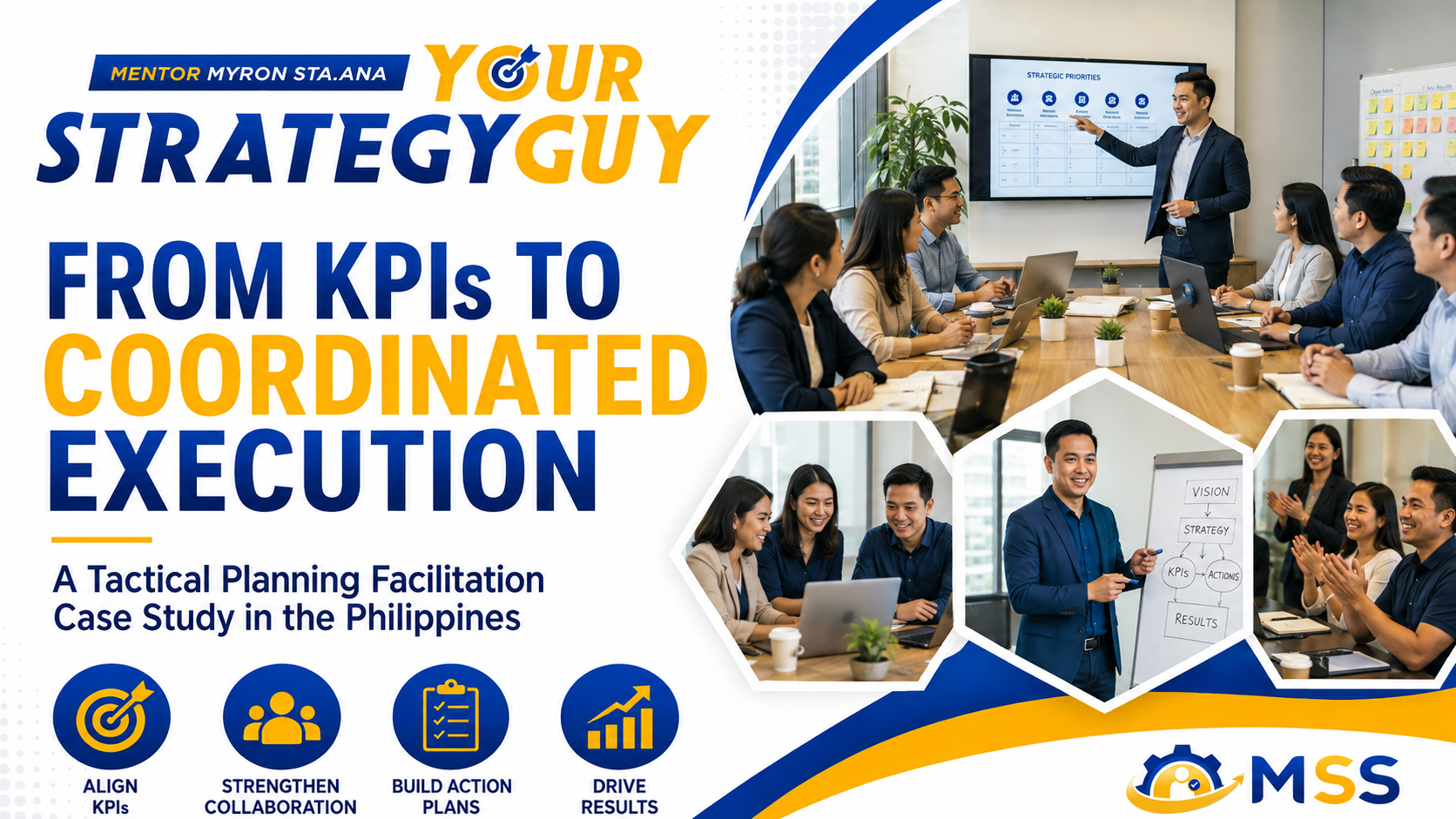
Annual planning becomes ineffective when every department prepares its own targets but fails to understand how its results depend on the rest of the organization.
This anonymized Tactical Planning Facilitation Case Study in the Philippines presents how an established Philippine credit-information, business-data, analytics, and risk-solutions company was guided through a concentrated tactical planning and business-review intervention. The engagement was designed to help its leaders and cross-functional teams review past performance, challenge proposed targets, recognize operational dependencies, strengthen collaboration, and prepare for more coordinated execution during the succeeding business year.
Rather than treating the event as another series of departmental presentations, the facilitated process converted performance information into organization-wide planning inputs. Department representatives presented their KPI updates, major accomplishments, lessons, proposed targets, priority initiatives, and team-structure requirements. The consulting team documented and analyzed the presentations, asked clarifying and challenging questions, and synthesized their implications for the wider organization.
The intervention also connected annual planning with the principles of the Balanced Scorecard. The framework considered financial results, customer and stakeholder outcomes, internal processes, and organizational capacity while emphasizing the importance of measurable targets and departmental action plans.
One of the most important themes was the need to work together beyond individual KPIs. Through an experiential “Missing Pieces” activity, participants experienced how departmental objectives could not be completed without cooperation, negotiation, information, and support from other functions. The activity demonstrated that departments may have separate responsibilities, but their processes and results remain interdependent.
A structured values-alignment discussion was also facilitated to identify the behavioral principles needed to support execution. Participants independently proposed values, explained their recommendations, consolidated overlapping ideas, and voted on the most important principles that should guide communication, decision-making, accountability, and cross-functional collaboration.
The resulting process created a stronger foundation for:
- Annual organizational priorities
- Refined departmental targets
- Cross-functional execution
- KPI and initiative alignment
- Departmental action planning
- Shared accountability
- Performance monitoring
- Culture and values alignment
This case study is relevant to business owners, chief executive officers, corporate planning leaders, Human Resources executives, department heads, and management teams looking for a Strategic Planning Consultant in the Philippines, Strategic Planning Facilitation Service in the Philippines, Tactical Planning Facilitator in the Philippines, KPI Alignment Consultant, or Strategy Execution Workshop Facilitator.
The embedded PDF below explains the intervention’s planning challenge, facilitation methodology, documented outputs, important lessons, and practical applications for organizations that need to convert strategy into coordinated departmental execution.
To protect client confidentiality, the company name, logos, executives’ names, employee identities, venue, exact dates, proprietary targets, financial figures, customer information, operational statistics, and sensitive strategies have been removed or generalized.
Check out our other Case Studies and Insights.
To know more about Your Strategy Guy, visit his social media pages on Facebook, LinkedIn, and Instagram.