

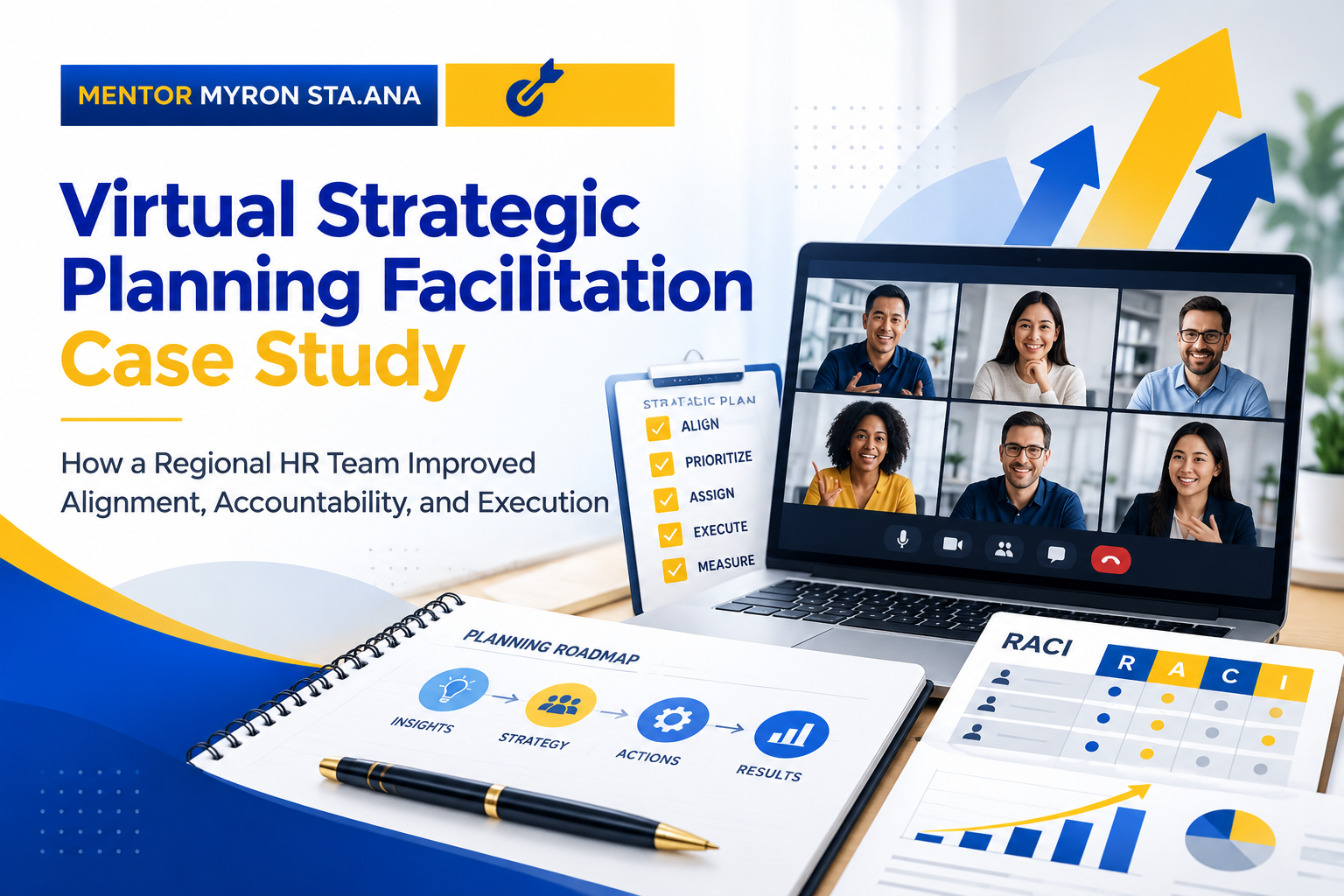
An anonymized Strategic Planning Consultancy and Facilitation Case Study in the Philippines
Executive Overview: Strategic Alignment Across Borders
Strategic planning becomes increasingly complex when the people responsible for implementation operate across different countries, cultures, regulations, reporting relationships, and organizational structures.
For a multinational organization, the challenge is not simply developing a corporate strategy. It is ensuring that geographically dispersed functional teams understand how their work contributes to the organization’s strategic direction—and who is responsible for delivering the agreed priorities.
This was the context of a virtual strategic planning engagement facilitated by MSS Business Solutions, now operating as Making Strong Success (MSS) Corporation, through Mentor Myron Sta. Ana and its team of professional facilitators and trainers.
The client was a multinational payments and financial technology services company with Human Resources operations across the Asia-Pacific region.
Rather than commissioning an entirely new enterprise-wide strategy, the organization required a focused planning intervention for its regional Human Resources function.
The engagement was designed to help regional HR leaders review their forthcoming annual activities, strengthen alignment with existing corporate and regional strategic priorities, clarify implementation responsibilities, and build relevant management capabilities.
The intervention combined virtual strategic planning facilitation, annual activity planning, Key Result Area discussions, RACI responsibility mapping, HR agility, and change management learning.
Its distinguishing feature was the integration of two important disciplines:
Planning what must be accomplished—and clarifying who must make it happen.
For organizations searching for a Strategic Planning Consultant or Strategic Planning Facilitator in the Philippines, this case demonstrates that strategic planning does not always require creating an entirely new corporate strategy.
Sometimes, the greater need is translating an existing strategy into coordinated functional plans and clearer execution accountability.
Confidentiality note: The client’s name, identifying details, individual participants, proprietary HR activities, specific responsibilities, and internal planning information have been withheld or generalized. This case study describes the documented engagement design and planning work, not unverified post-engagement performance results.
The Client Situation: One Regional HR Function, Multiple Operating Environments
The engagement involved Human Resources leaders and personnel supporting several countries across the Asia-Pacific region.
This created a planning environment different from that of a single-location company.
Regional Human Resources teams must coordinate activities while recognizing that individual countries may have different:
- Employment practices and legal requirements
- Workforce needs
- Operational priorities
- Reporting arrangements
- HR service responsibilities
- Local implementation schedules
- Stakeholder expectations
- Communication and coordination requirements
In such an environment, an annual activity calendar can become more complicated than it initially appears.
An activity may be applicable throughout the region, but its execution could require different arrangements from one country to another.
A responsibility assigned to a regional team might also require support from a shared services function or a local HR representative.
Without sufficient alignment, these situations can create uncertainty about who should perform the work, who approves decisions, whose input is required, and who should receive progress updates.
The planning requirement was therefore not simply to assemble a list of activities.
It was to create a more coordinated approach to the region’s upcoming HR commitments.
The central planning question
How can a geographically dispersed Human Resources function translate corporate and regional direction into a coordinated annual plan with clearer responsibilities for implementation?
This became the defining theme of the engagement.
Understanding the Actual Strategic Planning Need
One of the most important responsibilities of a professional Strategic Planning Consultant in the Philippines is determining what type of planning intervention the client genuinely requires.
Not every organization needs to begin with a new Vision, Mission, Values, SWOT analysis, and five-year Strategy Map.
In this case, the organization already operated within a broader corporate strategic environment.
Its regional HR function needed to ensure that its planned activities supported that existing direction.
The engagement therefore emphasized strategic alignment and operationalization.
Its intended outputs were:
- A reviewed and agreed annual HR activities calendar.
- A corresponding RACI responsibility matrix.
- Participant understanding of and commitment to implementation.
These were supported by sessions designed to improve collaboration, decision-making, organizational agility, and change readiness.
This distinction matters.
A corporate strategic planning engagement might involve developing a new enterprise-wide strategic architecture.
A functional planning engagement instead asks how an existing corporate strategy should guide the priorities, responsibilities, and activities of a particular function.
Both require strategic thinking.
But they do not require identical methodologies or deliverables.
The MSS Approach: An Alignment-Oriented Strategic Planning Process
The engagement was designed around an Alignment Model of Strategic Planning.
The purpose was to connect regional HR planning with the organization’s established corporate direction and regional strategic goals.
The methodology emphasized a logical progression:
Corporate Direction → Regional HR Priorities → Annual Activities → Key Result Areas → RACI Responsibilities → Implementation Commitments
Rather than treating the workshop as an isolated brainstorming exercise, the facilitation design addressed three connected questions.
Direction: Are the proposed activities consistent with what the organization is trying to accomplish?
Priorities: Which activities and areas of responsibility deserve attention during the planning period?
Accountability: Who must perform, approve, support, and monitor the work?
This framework provided a practical structure for a virtual planning engagement involving participants operating across different geographical locations.
Phase 1: Preparing the Groundwork Before the Virtual Workshop
Strategic planning quality depends significantly on what happens before the actual planning session.
In this engagement, the preparatory materials included working documents for the regional HR annual activities calendar and an existing RACI responsibility framework.
These materials gave the planning discussions a concrete starting point.
Instead of asking participants to create everything from scratch, the process could focus on reviewing, challenging, refining, and coordinating proposed commitments.
Reviewing the Annual HR Activities Calendar
An annual HR calendar is more than a schedule of events.
For a regional Human Resources function, it can serve as a shared planning reference covering recurring obligations, organizational programs, country-specific activities, and coordination requirements.
The working calendar included fields for activities, locations, due dates, responsible parties, and monthly schedules.
It also incorporated comments and suggested adjustments from regional participants.
This illustrates an important planning principle:
The quality of an annual plan improves when people who understand actual implementation requirements contribute before the formal planning discussion.
A proposed schedule may appear reasonable centrally but require adjustment when local operating realities are considered.
Pre-planning consultation helps surface those issues early.
Reviewing Existing Responsibility Arrangements
The supporting RACI workbook contained responsibilities distributed across regional HR and shared services roles.
This gave the facilitation process another useful starting point.
An existing responsibility matrix can help identify whether assignments are still appropriate, whether responsibilities require clarification, and where further agreement may be necessary.
The value of RACI is not merely creating a completed table.
Its value lies in the conversations required to reach agreement about accountability.
Phase 2: Reconnecting Regional Priorities With Corporate Direction
A foundational component of the planning agenda was leadership alignment.
The regional HR leadership was expected to revisit the organization’s Vision, Mission, Values, and established strategic direction.
This was important because a functional department should not develop its priorities independently of the organization it serves.
Human Resources initiatives should contribute to organizational goals rather than becoming disconnected programs selected simply because they are fashionable, familiar, or easy to implement.
For example, leadership development, recruitment improvements, HR process standardization, and employee engagement programs can all be valuable.
But their strategic relevance depends on the organization’s actual priorities.
A company pursuing expansion may require stronger recruitment and leadership pipelines.
A company pursuing operational efficiency may need better HR processes, systems, and workforce productivity.
A company undergoing transformation may require stronger change management and employee communication capabilities.
The correct question is therefore not merely:
What HR programs should be conducted next year?
It is:
Which HR priorities and activities will best support the organization’s strategic direction?
This is the fundamental difference between creating a departmental activity list and developing an aligned functional plan.
Phase 3: Looking Back Before Planning Forward
The Day 1 facilitation materials incorporated a review of the preceding year’s activities.
Participants were guided to examine organizational highlights and lowlights, including what had been accomplished, what had not been accomplished, and what should be reconsidered.
This retrospective approach supports better planning because organizations can repeat ineffective activities when they fail to examine previous experience.
A useful annual review should consider:
- Which planned activities were completed?
- Which commitments remained unfinished?
- Which initiatives produced the intended results?
- Which activities did not work as expected?
- Which opportunities were overlooked?
- What should be continued, improved, redesigned, or discontinued?
The facilitation materials also introduced a practical thinking aid summarized as C.R.E.A.T.E.:
| Letter | Strategic Thinking Prompt |
|---|---|
| C | Correct what needs correction |
| R | Replace what is no longer effective |
| E | Enhance what is already working |
| A | Align activities with strategic direction |
| T | Consider the timing of activities |
| E | Eliminate unnecessary or low-value activities |
The framework encouraged participants to look beyond maintaining existing practices simply because they were already familiar.
For organizations preparing an annual business plan, this is an important lesson.
The next year’s plan should not automatically be a copy of the previous year’s calendar with the dates changed.
Planning should involve organizational learning and deliberate improvement.
Phase 4: Turning Regional HR Priorities Into a Coordinated Annual Calendar
The central planning activity involved reviewing and refining the regional HR Calendar of Activities for the forthcoming year.
The facilitator’s role was to structure discussions, moderate contributions, support the consideration of different perspectives, and help the team work toward agreement.
For a geographically dispersed team, this required attention to participation and communication.
Participants represented different operating locations and responsibilities.
A disciplined virtual facilitation process helped create space for contributions rather than allowing the discussion to be dominated by a small number of voices.
Why a shared calendar matters
A shared regional planning calendar can help leadership answer several essential questions.
What needs to happen?
The calendar identifies the activity or commitment.
Where does it apply?
The geographic or organizational coverage becomes visible.
When must it happen?
Relevant deadlines and implementation periods are identified.
Who is expected to coordinate or perform it?
Responsibility can be connected with the activity.
What other teams must participate?
Cross-functional or cross-country dependencies can be identified.
These questions are especially important when regional activities involve both centralized and local execution.
A well-maintained calendar provides a common reference, but it still needs clear accountability and regular review.
That requirement led naturally to the next component of the engagement.
Phase 5: Using RACI to Clarify Responsibility and Accountability
One of the most transferable elements of the case study is the use of the RACI Responsibility Assignment Matrix.
RACI identifies four roles associated with a task, project, or deliverable.
R — Responsible
The person or team performing the work.
A — Accountable
The person ultimately answerable for the completion and approval of the work.
C — Consulted
Individuals or groups whose advice, expertise, or input is required.
I — Informed
Individuals or groups who need to receive relevant progress or outcome information.
The planning agenda incorporated time for discussing and refining responsibility assignments associated with the annual HR activities.
The broader management principle is straightforward:
A plan without clear accountability can become a collection of expectations that nobody fully owns.
Illustrative RACI Example
The example below is hypothetical and is not reproduced from the client’s proprietary planning documents.
| Activity | HR Project Lead | HR Executive | IT Team | Department Managers |
|---|---|---|---|---|
| Design an employee feedback survey | R | A | C | C |
| Configure the online survey platform | A | I | R | C |
| Approve the survey communication | R | A | I | C |
| Distribute results to relevant managers | R | A | I | I |
In practical applications, management should define one clear accountable role for each deliverable wherever possible, while assigning responsibility and consultation according to the organization’s actual operating model.
Why RACI improves planning
RACI helps make several questions explicit.
Who performs the work?
Who makes the final decision?
Who provides necessary expertise?
Who should be informed without needing to participate in every decision?
Who resolves disagreements about ownership?
These questions are often more important than the formatting of the final matrix.
A responsibility chart cannot substitute for management judgment.
However, it can make that judgment visible and easier to communicate.
Phase 6: Connecting Activities With Key Result Areas
The facilitation presentation also introduced Key Result Areas, or KRAs.
This was an important link between strategic priorities and departmental activities.
A Key Result Area identifies an area in which a department, team, or individual is expected to produce meaningful results.
For example, an HR department may have a strategic objective involving workforce capability.
A supporting Key Result Area might involve talent development.
The associated activities could include competency assessment, training, coaching, and capability-building interventions.
However, completing those activities is not automatically the same as achieving the intended result.
This distinction leads to a valuable strategic management question:
Are the activities being planned because they produce important results—or simply because they are activities the department normally performs?
An aligned planning process should encourage managers to understand the relationship among strategic objectives, KRAs, activities, and eventual performance measures.
Phase 7: Reinforcing Implementation Through Participant Commitment
The planning agenda included a participant commitment activity.
Its purpose was to connect the agreed planning discussions with individual responsibility for follow-through.
The planned activity invited participants to complete a commitment statement and contribute to a shared visual commitment poster.
Although symbolic commitment does not guarantee implementation, it can help reinforce the idea that planning decisions require personal ownership.
The deeper lesson is that alignment should extend beyond agreement with a document.
Participants need to understand what the approved priorities mean for their responsibilities.
They also need to recognize that the quality of execution will depend on action after the workshop—not merely participation during it.
A commitment activity is therefore most useful when connected with clear responsibilities, follow-up schedules, and management review.
Phase 8: Strengthening HR Agility and Change Readiness
The engagement was not limited to annual planning discussions.
The second day incorporated learning sessions intended to build capabilities relevant to the implementation environment.
The revised program focused on Agile Human Resources and Change Management, with supporting instruction on SWOT analysis and consensus decision-making.
This combination reflected an important principle:
Organizations need both sound plans and people capable of responding when circumstances change.
Agile Human Resources
The HR agility session introduced the realities of operating in a volatile, uncertain, complex, and ambiguous environment.
It addressed the need for adaptability in both thinking and working.
The learning content explored dimensions of agility such as:
- Mental agility
- People agility
- Change agility
- Results agility
- Self-awareness
These concepts are relevant to regional HR operations because different countries may experience changing workforce needs, regulations, business conditions, and organizational priorities.
An annual plan provides direction.
Agility helps teams respond when the environment requires appropriate adjustments.
Change Management
The change management component introduced the human side of organizational transformation.
Its supporting learning materials included the A.D.A.P.T. five-stage approach to embracing change:
A — Advise key organizational influencers about the change.
D — Devise the change management plan.
A — Align the relevant leadership, management, people, processes, and organizational resources.
P — Promote the change positively and build stakeholder buy-in and support.
T — Transition toward the intended change.
The broader learning content emphasized communication, stakeholder involvement, leadership support, readiness, and resistance management.
These topics complemented the planning activity because implementation frequently involves changes to established responsibilities, workflows, behaviors, and expectations.
The planning sessions helped address what the regional team intended to accomplish and who would be involved.
The learning sessions addressed capabilities that could support implementation and adaptation.
The Role of SWOT and Consensus Decision-Making
Another important distinction in this engagement was the use of strategic analysis and decision-making concepts as learning support.
SWOT analysis and consensus decision-making were incorporated into the learning-oriented portion of the revised agenda.
Their relevance extends beyond this particular workshop.
SWOT Helps Structure the Discussion
SWOT can help organizations identify internal strengths and weaknesses alongside external opportunities and threats.
For a functional team, this provides a useful way to examine the conditions influencing its priorities.
But SWOT should not be treated as a substitute for strategic choices.
The value comes from interpreting the findings and deciding what the organization should do.
Consensus Decision-Making Supports Alignment
Consensus decision-making provides structure for discussing proposed actions and reaching a workable agreement.
The facilitation materials introduced stages such as clarifying the issue, discussing alternatives, exploring ideas, forming and refining proposals, testing agreement, and determining implementation.
Consensus does not mean every participant must receive everything requested.
It means that a decision-making process should allow relevant perspectives to be considered before the group moves toward an agreed direction.
For cross-border or cross-functional teams, this discipline can be particularly valuable.
What the Engagement Was Designed to Produce
The documented facilitation design identified several concrete planning outputs.
| Work Component | Intended Output or Contribution |
|---|---|
| Corporate and regional alignment | Regional HR activities considered against established organizational direction |
| Previous year review | Reflection on accomplishments, gaps, and planning lessons |
| Annual activity planning | Reviewed and refined annual HR activities calendar |
| KRA discussion | Clearer understanding of areas requiring results |
| Responsibility mapping | RACI assignments linked to HR activities |
| Participant commitment | Reinforcement of individual responsibility for execution |
| HR agility learning | Awareness of adaptability and organizational responsiveness |
| Change management learning | Understanding of stakeholder buy-in, communication, and change readiness |
| SWOT and consensus learning | Additional tools for analysis and group decision-making |
Working calendar and RACI documents are part of the engagement records.
However, the available materials do not provide a complete post-workshop validation report or an independent assessment of subsequent implementation.
The documented contribution is therefore best understood as a structured strategic alignment and implementation planning engagement, supported by practical working documents and targeted capability-building.
It should not be presented as proof that every initiative was subsequently implemented or that specific business performance improvements resulted from the workshop.
Before and After: The Intended Planning Transformation
The value of this engagement can be illustrated by comparing the planning conditions it sought to address with the management practices it was designed to strengthen.
These are intended changes in planning discipline, not verified before-and-after performance measurements.
| Planning Challenge | Stronger Management Practice |
|---|---|
| Activities considered primarily within individual functions or locations | Shared regional review of planned activities |
| Potentially disconnected activity priorities | Explicit consideration of corporate and regional strategic direction |
| Calendar entries without complete implementation clarity | Discussion of responsibilities through RACI |
| Existing activities carried forward routinely | Reflection on what to correct, replace, enhance, align, time, or eliminate |
| Geographically dispersed participants | Structured virtual discussions and opportunities for contribution |
| Agreement limited to workshop discussions | Explicit commitment and follow-through expectations |
| Planning focused only on tasks | Greater attention to KRAs, agility, and managing organizational change |
The most important intended shift was from a calendar of planned work toward a more strategically aligned calendar with clearer implementation responsibilities.
Five Strategic Management Lessons for Philippine Organizations
Although the engagement involved an international HR function, its lessons are highly relevant to Philippine businesses, corporations, government institutions, cooperatives, and other organizations.
Lesson 1: Not Every Planning Engagement Needs a New Corporate Strategy
Sometimes the organization already has an appropriate strategic direction.
What it lacks is alignment between the corporate strategy and the plans of departments, business units, branches, or regional operations.
Before commissioning a planning workshop, leadership should ask whether the priority is strategy formulation, strategy review, annual planning, departmental cascading, or execution alignment.
The intervention should address the actual requirement.
Lesson 2: An Activity Calendar Is Not Automatically a Strategic Plan
An annual calendar can be useful for coordinating recurring activities.
But it becomes more strategically meaningful when management can explain how its entries support important organizational goals.
Activities should not be approved simply because the department conducted them last year.
They should be reviewed for relevance, timing, feasibility, and contribution.
Lesson 3: Alignment Requires More Than Agreement With Leadership’s Direction
Departments may agree with the company’s strategic goals while remaining uncertain about their own contributions.
Leadership should translate those goals into appropriate functional responsibilities, KRAs, measures, initiatives, and implementation expectations.
The goal is to create a line of sight between organizational strategy and daily management work.
Lesson 4: Responsibility Mapping Is a Practical Execution Discipline
Plans can become delayed or confused when responsibility is unclear.
RACI can help clarify the distinction between performing work, approving it, providing input, and receiving information.
Its value is especially significant when implementation requires coordination among several departments, branches, or operating locations.
Lesson 5: Strategic Planning and Change Management Should Reinforce One Another
A plan may require employees to work differently, acquire new capabilities, use new systems, or accept revised responsibilities.
These changes create human and organizational requirements that should not be ignored.
Effective strategy execution therefore depends not only on planning quality but also on leadership, communication, capability, organizational readiness, and sustained management attention.
How Does This Relate to the Balanced Scorecard?
The Balanced Scorecard is widely used to connect strategic objectives with performance measures, targets, and initiatives.
However, this particular engagement should not be confused with a complete Balanced Scorecard development project.
Its documented emphasis was on regional HR alignment, annual activities, KRAs, responsibilities, and change-related learning.
Nevertheless, the case illustrates principles that complement Balanced Scorecard-based strategic management.
A Balanced Scorecard helps answer:
What strategic results must the organization achieve, and how will progress be measured?
A functional activity plan helps answer:
What work must be undertaken to support those results?
A RACI matrix helps answer:
Who is responsible, accountable, consulted, and informed?
A review mechanism helps answer:
Are the planned actions progressing, and what adjustments are necessary?
For organizations using a Balanced Scorecard, these components can be connected in a practical hierarchy:
Strategic Objective → Performance Measure → Target → Initiative → Functional Activities → RACI Ownership → Execution Review
This is an illustrative strategic management integration, not a claim that all these elements were developed during the client’s engagement.
The distinction is important because different tools address different management questions.
A scorecard measures strategic performance.
An activity calendar schedules work.
A RACI matrix clarifies responsibility.
None should be mistaken for a complete substitute for the others.
Why Professional Virtual Strategic Planning Facilitation Matters
Conducting strategic planning virtually requires more than transferring a face-to-face agenda to a video-conferencing platform.
The facilitator must design discussions around participant involvement, clarity, time management, and practical outputs.
Remote planning introduces additional challenges.
Participants may operate in different locations.
Some may be reluctant to interrupt senior colleagues.
Discussions can become dominated by a few speakers.
Detailed documents may require simultaneous review.
Participants may struggle to distinguish between information sharing, brainstorming, and final decision-making.
The planning process therefore benefits from structured questions, clear instructions, moderated discussions, shared working materials, periodic synthesis, and explicit decisions.
In this engagement, the facilitation design incorporated an organized sequence of discussions, energizers, review points, responsibility-mapping activities, and participant commitment.
The objective was to keep the virtual engagement centered on actual planning work rather than allowing it to become a series of passive presentations.
The broader lesson is that successful virtual facilitation is determined less by the platform being used and more by the quality of the process being facilitated.
What Should Leaders Prepare for a Similar Strategic Planning Engagement?
Organizations considering virtual or hybrid strategic planning can strengthen preparation by ensuring that several essential elements are ready before the planning proper.
| Planning Requirement | Recommended Preparation |
|---|---|
| Corporate direction | Provide the current Vision, Mission, Values, and relevant strategic goals |
| Previous performance | Prepare a concise review of completed, unfinished, and ineffective initiatives |
| Functional priorities | Identify the department’s major areas of responsibility |
| Draft annual plan | Consolidate proposed activities, priorities, and schedules |
| Dependencies | Identify departments, locations, or teams required for implementation |
| Responsibility arrangements | Prepare existing role descriptions or RACI matrices for review |
| Decision authority | Ensure appropriate decision-makers participate |
| Participation | Establish a structured approach for involving all relevant participants |
| Documentation | Assign responsibility for capturing agreements and revisions |
| Follow-through | Determine who will validate outputs and how progress will be reviewed |
This preparation makes it easier for the facilitator to concentrate on strategic discussion and decision-making rather than spending most of the workshop gathering basic information.
When Should an Organization Engage a Strategic Planning Consultant in the Philippines?
A Strategic Planning Consultant can help when organizational leaders need advice on what type of planning process is appropriate, what analysis is necessary, which management frameworks to use, how strategic objectives should be translated into functional plans, or how performance-management and execution systems can be connected.
For organizations already operating under an established strategic plan, consultancy may focus on strategic alignment, annual planning, cascading, accountability, or implementation architecture rather than creating a new strategy from the beginning.
A comprehensive engagement may also incorporate SWOT and environmental analysis, Strategy Map development, Balanced Scorecard formulation, KPI development, target setting, and strategic initiative planning where those deliverables are within the agreed scope.
What Is the Role of a Strategic Planning Facilitator in the Philippines?
A Strategic Planning Facilitator guides the group process through which management evaluates issues, discusses alternatives, makes decisions, and reaches alignment.
In cross-functional or cross-border planning, this role is particularly important because different participants may hold different priorities, operational knowledge, and implementation responsibilities.
The facilitator helps ensure that relevant perspectives are considered and that discussions progress toward usable decisions.
The organization remains responsible for its own strategic choices.
The facilitator contributes the process, structure, questions, and decision-making discipline.
When Are Strategic Planning Training, Speaking, and Coaching Useful?
Different organizations require different forms of professional strategic-management support.
Strategic Planning Training can help leaders develop competence in strategic thinking, SWOT, PESTLE, Strategy Maps, Balanced Scorecards, KPIs, RACI, and strategy execution.
Strategic Planning Speaking can help introduce strategic-management concepts, challenge conventional thinking, or stimulate executive discussion during leadership conferences and organizational events.
Strategic Planning Coaching can provide continuing support to executives and planning leaders who need help with prioritization, decision-making, strategic review, or execution challenges.
These interventions are complementary but should not be treated as interchangeable.
The appropriate service depends on whether the organization needs technical guidance, facilitated decisions, capability development, executive learning, or continuing support.
Frequently Asked Questions
Can strategic planning be conducted effectively online?
Yes. Virtual strategic planning can support meaningful discussion, prioritization, responsibility assignment, and planning outputs when participants are prepared and the process is designed for active involvement rather than passive presentations.
Its effectiveness depends on factors such as leadership participation, facilitation quality, decision authority, document readiness, and follow-through.
How is functional strategic planning different from corporate strategic planning?
Corporate strategic planning determines the organization’s broader direction, goals, objectives, and priorities.
Functional strategic planning translates relevant corporate priorities into the objectives, initiatives, responsibilities, and plans of a department or function.
The two should reinforce one another.
What is the difference between an annual activity calendar and a strategic plan?
An activity calendar identifies planned work and schedules.
A strategic plan identifies the organization’s direction, strategic choices, objectives, and intended results.
The calendar becomes more strategically meaningful when its activities are connected with strategic objectives and appropriate performance expectations.
Why is RACI important in strategic planning?
RACI clarifies who is responsible for completing work, who is accountable for results, whose input is needed, and who must remain informed.
It is especially useful when initiatives require collaboration among multiple functions, departments, or locations.
Should a Strategic Planning Consultant always use the Balanced Scorecard?
No. The Balanced Scorecard can be highly effective when the organization needs interconnected strategic objectives, measures, targets, and initiatives.
However, some engagements require a narrower intervention, such as strategy review, annual planning, RACI development, or functional alignment.
The framework should match the actual requirement.
Can a Philippine Strategic Planning Facilitator support multinational organizations?
Yes. A qualified facilitator based in the Philippines can support virtual or face-to-face planning involving participants from different countries, provided that the engagement is appropriately designed around the organization’s requirements, working arrangements, and decision-making structure.
What should happen after a virtual strategic planning workshop?
Outputs should be validated by authorized leadership, communicated to those responsible for implementation, connected with relevant measures and review schedules, and updated when circumstances require.
The workshop should initiate management action rather than become the final activity of the planning process.
Conclusion: Strategic Alignment Must Eventually Become Clear Responsibility
The central lesson of this case study is that strategic planning does not become valuable simply because leaders agree on a direction.
Value emerges when that direction influences organizational choices, functional priorities, implementation responsibilities, and management behavior.
For geographically dispersed teams, the need for alignment becomes even more significant.
A shared strategic direction provides coherence.
An annual plan provides structure.
Key Result Areas establish areas of expected results.
A RACI matrix clarifies responsibility.
Agility and change management help people navigate implementation requirements.
Together, these disciplines can provide a stronger foundation for coordinated execution.
The planning principle applies to organizations of virtually every size and sector:
A strategy cannot be executed consistently when the people responsible for implementation do not share a clear understanding of what must be done, why it matters, and who owns the work.
That is why effective strategic planning should move beyond preparing documents.
It should connect direction, priorities, decisions, responsibilities, and execution.
Looking for a Strategic Planning Consultant or Facilitator in the Philippines?
Your Strategy Guy, led by Mentor Myron Sta. Ana, provides customized Strategic Planning Consultancy, Facilitation, Training, Speaking, and Coaching services for private companies, corporations, government institutions, cooperatives, associations, and other organizations in the Philippines.
Services can be designed around different strategic-management requirements, including:
- Corporate and organizational strategic planning
- Business planning and annual planning
- Virtual and face-to-face strategic planning facilitation
- Departmental and functional strategic alignment
- Strategy Map development
- Balanced Scorecard development
- KPI and performance scorecard development
- Strategic initiative planning
- RACI and execution accountability
- Strategic cascading and tactical planning
- Strategy execution reviews
- Leadership and management capability-building
The starting point is identifying what the organization actually needs to improve: strategic direction, alignment, planning discipline, measurement, accountability, or execution.
From Strategic Direction to Coordinated Action.
From Shared Priorities to Clear Accountability.
From Planning to Execution.
Explore strategic planning consultancy and facilitation services at www.YourStrategyGuy.com.