

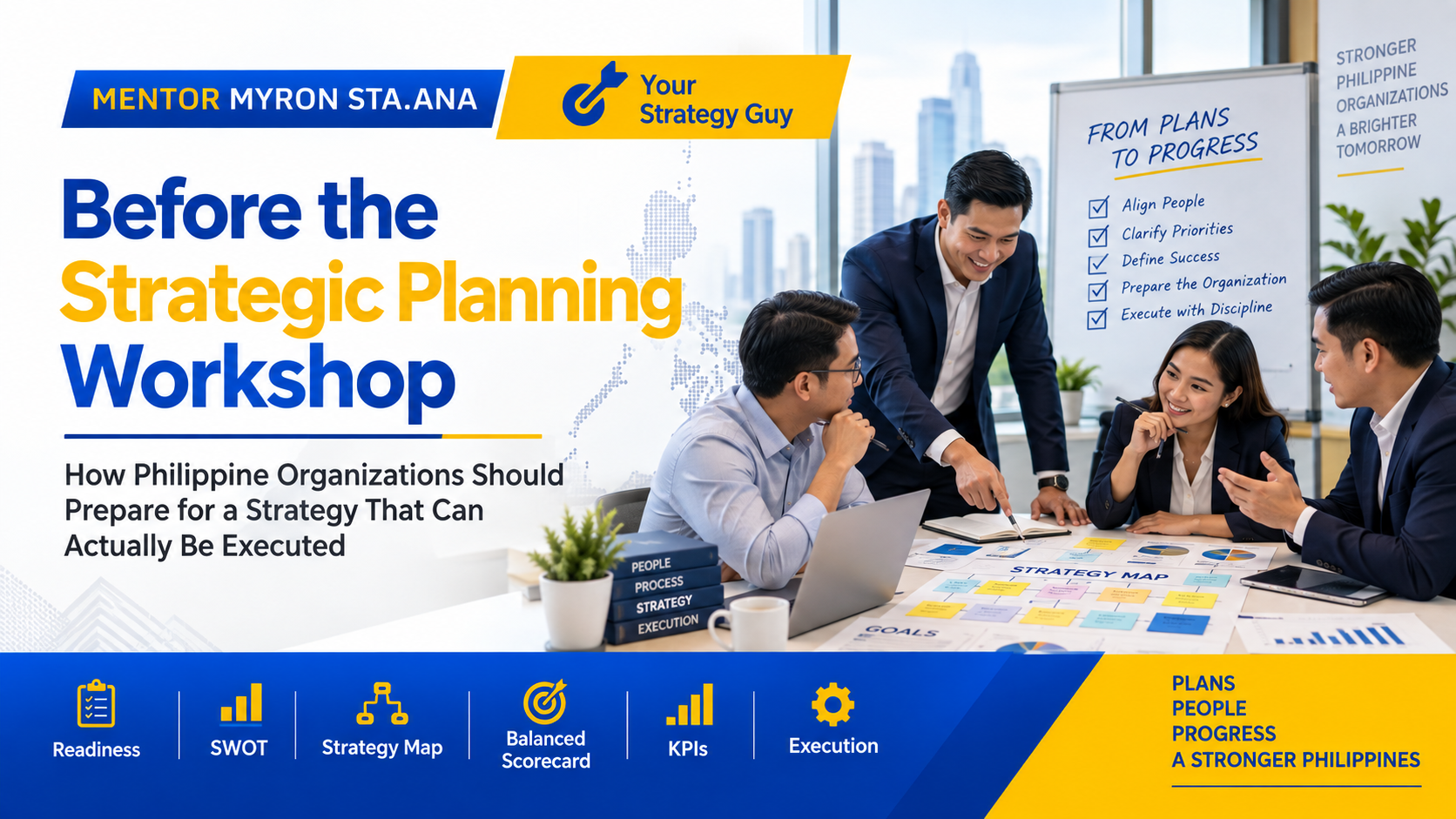
Before the Strategic Planning Workshop: How Philippine Organizations Should Prepare for a Strategy That Can Actually Be Executed
A Practical Guide for Corporate Planning Heads, HR Leaders, OD Heads, CEOs, and Management Teams Looking for a Strategic Planning Consultant or Facilitator in the Philippines
Most organizations think strategic planning begins when executives enter the conference room.
It does not.
By the time the President, CEO, business unit heads, Corporate Planning team, Human Resources leaders, and department heads sit down for a strategic planning workshop, a significant part of the quality of the eventual strategy has already been determined.
It has been determined by the quality of the information gathered beforehand, the clarity of the planning mandate, the readiness of the participants, the availability of evidence, the involvement of decision-makers, and the organization’s willingness to confront questions that may be uncomfortable.
This is one reason organizations looking for a Strategic Planning Consultant in the Philippines or a Strategic Planning Facilitator in the Philippines should not evaluate providers solely by asking:
“How many days will you facilitate our workshop?”
A better question is:
“How will you help us become ready to make good strategic decisions during the workshop?”
Because a two-day or three-day strategic planning session cannot compensate for several months—or several years—of missing information, unclear priorities, poor preparation, or decisions that nobody in the room is authorized to make.
For Philippine organizations preparing for their next strategic planning cycle, the quality of the pre-planning process can be just as important as the planning proper.
Strategic Planning Does Not Start With SWOT
One of the most common approaches to strategic planning is to gather the management team and immediately ask everyone to identify:
Strengths. Weaknesses. Opportunities. Threats.
SWOT is useful.
But SWOT should not be the first thought an organization gives to its strategy.
Before leaders classify something as a strength or weakness, they should already understand what the organization is trying to accomplish.
Before they call something an opportunity, they should have enough external information to determine whether the opportunity is significant.
Before they label something a threat, they should understand whether it can materially affect the organization’s direction.
And before any of those findings can become strategy, leadership has to determine which issues actually deserve strategic attention.
A well-designed strategic planning process therefore begins with strategic readiness, not with filling four boxes on a worksheet.
The First Question Should Be: Why Are We Planning Now?
Every strategic planning engagement should begin with a clear reason.
Is the existing strategic plan ending?
Has the organization undergone a leadership transition?
Has the business grown significantly?
Is the company entering new markets?
Has the industry changed?
Are departments operating without a common direction?
Are existing KPIs no longer helping management make decisions?
Is the organization facing declining performance?
Has a new law or regulation changed the environment?
Is the company preparing for expansion, restructuring, digital transformation, succession, investment, or another major change?
Different reasons require different planning designs.
An organization that simply needs to refresh priorities for the next year should not automatically undergo the same process as a company developing a completely new five-year strategy.
Similarly, an executive team that already has strong environmental intelligence, reliable performance information, and an agreed corporate direction may need intensive facilitation rather than extensive diagnostic consultancy.
This is where an experienced Filipino Strategic Planning Consultant adds value before the workshop even begins: helping leadership determine what type of planning intervention the organization actually needs.
Clarify the Planning Horizon Before Discussing the Strategy
Another deceptively simple decision is the planning period.
Are you developing a:
Three-year plan? Five-year plan? Annual strategy refresh? Mid-term review? Tactical plan?
The horizon affects the kind of questions leadership should ask.
Annual planning tends to focus more heavily on execution, budgets, departmental priorities, and short-term commitments.
A three- to five-year strategic plan requires broader thinking about:
market evolution, organizational capability, technology, competition, customer expectations, regulatory changes, talent requirements, investment needs, and the organization’s desired future position.
This is also why strategic and tactical planning should not be mixed carelessly.
The strategic plan tells leadership where the organization intends to go and what major outcomes matter.
The tactical plan translates those priorities into shorter-term initiatives, departmental actions, resources, and accountability.
Trying to solve both questions simultaneously without structure often produces a planning workshop filled with operational details but very little actual strategy.
Decide Who Really Needs to Be in the Room
Strategic planning is not improved merely by increasing the number of participants.
The more important question is whether the right people are participating.
A planning team normally needs people who can contribute at least one of several essential perspectives: organizational authority, institutional knowledge, customer knowledge, operational expertise, market intelligence, financial understanding, people and capability insights, or responsibility for execution.
More importantly, participants should include people who can actually make or influence strategic decisions.
If every difficult issue has to be deferred because:
“We need to ask the President.”
or
“The Board needs to decide that.”
then the organization may have invited participants to a strategic discussion without inviting enough of the people who have the authority to make strategy.
On the other hand, including every manager simply because they hold a managerial title can also make the workshop unnecessarily difficult.
An experienced Strategic Planning Facilitator in the Philippines helps the client determine who should participate, who should provide inputs before the workshop, who should be consulted separately, and who should eventually receive the strategy through cascading.
Corporate Planning Should Prepare Evidence, Not Just Templates
Corporate Planning teams frequently become the central coordinators of strategic planning.
Their role before the workshop should go beyond reserving the venue, distributing templates, consolidating presentations, and preparing the agenda.
The Corporate Planning function should help establish an evidence base for strategic decisions.
That may include historical organizational performance, previous strategic objectives, performance against existing KPIs, unfinished strategic initiatives, market and industry information, customer data, competitor information, regulatory developments, previous planning assumptions, existing budgets, operational constraints, and lessons from past execution.
The point is not to overwhelm executives with hundreds of pages of data.
The purpose is to make sure that strategic conversations are informed by reality.
A management team debating whether customer experience has improved should ideally have customer information.
A team debating whether the company needs to expand should understand capacity, demand, financial implications, and market potential.
A leadership team debating whether people capability is a strategic issue should have more than anecdotal complaints about employees.
Good strategy requires judgment. Good judgment requires relevant information.
HR and OD Have a Bigger Strategic Role Than Organizing the Event
In many Philippine organizations, Human Resources or Organizational Development is tasked with coordinating strategic planning.
That can sometimes result in HR being treated primarily as the organizer.
Venue.
Food.
Participant confirmations.
Accommodation.
Materials.
Certificates.
Program flow.
Those tasks matter, but they are not the most strategic contribution HR and OD can make.
HR and OD should help leadership determine whether the organization currently has the people, competencies, structure, leadership capability, culture, succession depth, and workforce capacity required by the future strategy.
Suppose leadership wants aggressive expansion.
Does the organization have enough management capability to support it?
Suppose the strategy depends heavily on digitalization.
Does the workforce have the required competencies?
Suppose strategic execution requires stronger accountability.
Does the current performance management system reinforce accountability?
Suppose the company wants to become more customer-centric.
Do recruitment, training, recognition, performance evaluation, and leadership behavior actually reinforce customer-centricity?
This is where strategic planning and organizational development meet.
A strategy may look excellent on paper but still be impossible for the current organization to execute without capability-building.
Executives Should Enter the Workshop Ready to Make Choices
Strategic planning is not primarily about generating more ideas.
Most leadership teams already have too many ideas.
The difficult part is choosing.
Which markets deserve attention?
Which opportunities should the company decline?
Which customer segments matter most?
Which capabilities deserve investment?
Which processes require transformation?
Which initiatives should stop?
Which strategic priorities should receive resources first?
Which measures actually indicate progress?
Which organizational problems are strategic enough to deserve executive attention?
A planning workshop becomes weak when executives enter expecting the facilitator to somehow manufacture consensus without leadership making difficult trade-offs.
A good Filipino Strategic Planning Facilitator creates the conditions for productive discussion, challenges assumptions, structures decisions, and manages alignment.
But the facilitator should not make the organization’s strategic choices on behalf of management.
The organization must own the strategy.
Review the Previous Strategy Before Creating the Next One
One of the most valuable pre-planning exercises is also one of the most frequently neglected:
What happened to the previous strategic plan?
Leadership should review not only whether targets were achieved but also why.
If a target was achieved, what contributed to it?
If it was not achieved, what prevented it?
Were the assumptions wrong?
Was ownership unclear?
Was the KPI poorly designed?
Were resources insufficient?
Did external conditions change?
Was the initiative never implemented?
Was the strategy itself flawed?
Was the organization simply distracted by day-to-day operations?
This is not about assigning blame.
It is about organizational learning.
Otherwise, the next planning workshop may produce a new version of the same commitments that failed previously.
Separate Strategic Issues From Operational Problems
Every planning workshop eventually produces a long collection of problems.
Late reports.
Slow approvals.
Staffing concerns.
Customer complaints.
Technology problems.
Process inefficiencies.
Communication gaps.
Inventory concerns.
Budget constraints.
Sales concerns.
Training needs.
Not every problem belongs on the Strategy Map.
Strategic planning requires leaders to distinguish among:
strategic issues, operational problems, tactical concerns, and routine management responsibilities.
A strategic issue usually has a meaningful relationship with the organization’s long-term direction, competitiveness, sustainability, stakeholder value, major capabilities, or ability to achieve its desired future.
A broken office printer may be a problem.
It is rarely a strategic issue.
An organization-wide technology limitation that prevents scalability, customer responsiveness, or effective decision-making may be strategic.
That distinction protects the strategic plan from becoming an enormous organizational to-do list.
Do Not Accept Every “Weakness” at Face Value
Suppose managers identify:
High employee turnover.
That is a weakness.
But what is driving it?
Compensation?
Leadership?
Recruitment quality?
Career opportunities?
Workload?
Job design?
Culture?
Poor onboarding?
Management behavior?
Work environment?
Competitors hiring away employees?
Several causes may require completely different strategic responses.
The same logic applies to declining sales, customer dissatisfaction, slow processes, low productivity, or poor coordination.
That is why root-cause analysis belongs in strategic planning.
A Strategic Planning Consultant should help participants avoid building expensive initiatives around symptoms.
External Analysis Must Go Beyond Reading the News
Environmental scanning is another area where strategic planning can become superficial.
Teams may identify inflation, artificial intelligence, government policy, elections, new regulations, changing demographics, sustainability, or economic conditions.
But merely naming an external development is not strategy.
Leadership must ask:
What does this mean for us?
If artificial intelligence is changing the industry, what opportunity or threat does it create for this particular organization?
If customer behavior is changing, what part of the value proposition must respond?
If regulation changes, which processes or capabilities are affected?
If the economy slows, which assumptions in the strategic plan need adjustment?
PESTLE analysis becomes useful when it produces strategic implications, not when it merely produces a list of external events.
The Balanced Scorecard Should Come After Strategic Thinking
Some organizations begin planning by opening a Balanced Scorecard template.
Then they try to fill the Financial, Customer, Internal Process, and Learning and Growth perspectives.
That reverses the logic.
The Balanced Scorecard is not supposed to manufacture strategy.
It is supposed to help organize, communicate, measure, and manage strategy.
Leadership should first understand the major strategic issues and choices.
Then strategic objectives can be organized into a coherent Strategy Map.
Only after that should the organization determine the measures, targets, and initiatives required to manage those objectives.
A practical sequence is:
| Strategic Question | Planning Output |
|---|---|
| Where are we now? | Situational analysis |
| What is changing around us? | Environmental and competitive insights |
| What really matters? | Strategic issues/priorities |
| Where do we want to go? | Strategic goals |
| How will we get there? | Strategic objectives |
| How do the objectives connect? | Strategy Map |
| How will we know we are progressing? | Measures/KPIs |
| What level of performance is expected? | Targets |
| What must we do differently? | Strategic initiatives |
| Who must make it happen? | Ownership and cascading |
| How will leadership govern execution? | Strategic review system |
This is where working with a Balanced Scorecard Consultant in the Philippines who also understands strategic planning and facilitation can be more valuable than simply downloading a scorecard template.
Do Not Choose KPIs Until the Strategic Objective Is Clear
A KPI answers:
How will we know whether this strategic objective is progressing or succeeding?
Therefore, the objective has to come first.
When organizations choose KPIs too early, they often inherit whatever metrics departments already report.
That creates a scorecard full of measures but not necessarily a scorecard full of strategic measures.
For example, HR may already report the number of training hours.
But if the strategic objective is to strengthen leadership capability, training hours alone may not demonstrate whether leadership capability improved.
Marketing may report social media reach.
But if the strategic objective concerns qualified demand generation, reach may not be the strongest indicator.
Operations may count activities.
But strategic management needs evidence of outcomes.
The principle is simple:
Do not measure something merely because it is easy to count. Measure it because it helps management understand whether the strategy is working.
Targets Need a Baseline
Another common mistake is target-setting without historical context.
If management says:
“Let’s achieve 95%.”
the next question should be:
“What is our current performance?”
If the current level is already 94%, a 95% target may not represent much strategic ambition.
If the current level is 30%, reaching 95% next year may be unrealistic without a major transformation.
Targets should therefore be informed by some combination of:
historical performance, baseline data, benchmark information, strategic ambition, available capability, resources, environmental conditions, and the speed at which meaningful change can reasonably occur.
A target should create direction and accountability.
It should not become an arbitrary number generated because the spreadsheet needed something in the target column.
Initiatives Should Be Tested Against Measures
Another discipline can dramatically improve a strategic plan:
For every proposed strategic initiative, ask:
Which strategic objective and KPI is this supposed to move?
If the organization cannot answer that question, leadership should challenge whether the initiative belongs in the strategic plan.
Organizations frequently accumulate projects because someone considers each project beneficial.
But the strategic plan is not a warehouse for every useful project.
The strongest strategic initiatives are deliberately selected because they help close the gap between current performance and desired strategic performance.
Budget Conversations Cannot Be Completely Separated From Strategy
Strategy requires choices about resource allocation.
An organization cannot claim that something is strategically important indefinitely while refusing to allocate people, leadership attention, technology, capital, time, or budget toward it.
This does not mean that every strategic decision requires immediate spending.
Some strategies involve stopping activities, simplifying processes, reallocating existing resources, redesigning responsibilities, or changing management behavior.
But the planning team should eventually ask:
What will executing this strategy require?
Without that conversation, organizations risk approving strategies whose resource requirements were never considered.
What Should Be Ready Before the Strategic Planning Workshop?
For Philippine organizations preparing to engage a Strategic Planning Consultant or Facilitator, the following readiness sequence is practical:
| Before the Workshop | What Leadership Should Clarify |
|---|---|
| Planning mandate | Why the organization is planning now |
| Planning horizon | Annual, three-year, five-year, or another period |
| Participants | Decision-makers, contributors, and stakeholders |
| Previous plan | Achievements, gaps, unfinished initiatives, lessons |
| Internal performance | Relevant financial and non-financial evidence |
| Customer/stakeholder intelligence | Needs, feedback, behavior, experience |
| External environment | Market, competitors, economy, regulation, technology and other forces |
| Organizational capability | Structure, people, leadership, systems, technology and culture |
| Strategic issues | The few matters that could materially influence future success |
| Decision authority | Which strategic choices can actually be decided during the session |
| Expected outputs | Strategy Map, objectives, KPIs, targets, initiatives, action plans, or other deliverables |
| Post-planning process | Documentation, cascading, implementation and review |
A professional strategic planning engagement should help the client determine which of these must be completed in advance and which should be facilitated during the actual planning proper.
How Corporate Planning, HR, and OD Should Work Together
One of the strongest arrangements for strategic planning is when Corporate Planning, HR/OD, Finance, and executive leadership operate as complementary partners.
Corporate Planning can bring strategic and performance information.
Finance can help test resource implications.
HR and OD can assess organizational capability.
Operating leaders can contribute customer, process, operational, and market realities.
Top management provides strategic judgment and decision authority.
The facilitator integrates these perspectives into a structured decision-making process.
This prevents strategic planning from becoming:
an HR event, a Corporate Planning document, a Finance exercise, or the CEO’s personal strategy.
It becomes an organizational strategy.
When Should You Hire an External Strategic Planning Facilitator in the Philippines?
Organizations do not always need an external facilitator.
A highly mature leadership team with strong internal planning capability may be able to facilitate its own process effectively.
External facilitation becomes particularly valuable when the organization needs neutrality, stronger structure, an independent challenger, specialized frameworks, difficult executive alignment, cross-functional participation, disciplined decision-making, or someone who can concentrate entirely on the quality of the process while leadership concentrates on the substance of the decisions.
This is especially relevant when the person who would normally facilitate internally is also one of the executives who needs to actively debate and advocate during the planning process.
It is difficult to be simultaneously:
the decision-maker, participant, challenger, timekeeper, process designer, conflict manager, recorder, and neutral facilitator.
An external Filipino Strategic Planning Facilitator can separate those responsibilities.
What Should You Look for in a Strategic Planning Consultant in the Philippines?
Prospective clients should look beyond whether a consultant can deliver an energetic workshop.
Ask about the process.
How will the consultant diagnose the need?
What happens before the planning proper?
How will participants prepare?
How will internal and external information be used?
What framework will be used, and why?
How will the facilitator handle disagreement?
How will strategic goals become measurable objectives?
How will KPIs and targets be developed?
How will initiatives be aligned?
What will happen after the workshop?
What exactly will the organization receive?
A strategic planning consultant should not merely provide more talking time.
The engagement should improve the quality of organizational thinking and decision-making.
Strategic Planning Consultant or Strategic Planning Facilitator: Which One Do We Need?
The distinction is useful.
A Strategic Planning Consultant contributes expertise, diagnosis, frameworks, analysis, recommendations, and advisory guidance.
A Strategic Planning Facilitator manages the group process through which leaders discuss, challenge, decide, prioritize, and align.
Many comprehensive engagements need both.
If the organization already understands exactly what it needs and simply requires an impartial professional to guide the workshop, facilitation may be enough.
If the organization’s strategic issues still need diagnosis, the planning design still needs to be developed, or the outputs require deeper technical work such as a Strategy Map, Balanced Scorecard, KPIs, or cascading, consultancy may also be required.
The important thing is not the label.
The important thing is matching the intervention to the organization’s actual need.
Frequently Asked Questions
What does a Strategic Planning Consultant in the Philippines do?
A Strategic Planning Consultant helps leadership diagnose the organization’s current situation, structure the planning process, identify strategic issues, develop strategic goals and objectives, establish measurement and execution frameworks, and strengthen the connection between strategy and implementation.
What does a Strategic Planning Facilitator in the Philippines do?
A Strategic Planning Facilitator guides the planning conversation. The facilitator manages participation, keeps discussions structured, challenges assumptions, handles competing perspectives, supports consensus-building, and helps the leadership team convert discussion into strategic decisions and documented outputs.
What is the advantage of hiring a Filipino Strategic Planning Consultant?
For Philippine organizations, a Filipino Strategic Planning Consultant can bring familiarity with the local business, government, labor, cultural, and organizational environment while still applying internationally established strategic management tools and frameworks. The value, however, should ultimately be evaluated based on the consultant’s methodology, relevant experience, facilitation capability, and ability to help the organization produce usable outputs.
How many days should a strategic planning workshop take?
There is no universal answer. The appropriate duration depends on the complexity of the organization, planning horizon, amount of pre-work completed, number of participants, maturity of the existing strategy, and expected outputs. A shorter planning proper can work when significant analysis and preparation have already been completed beforehand.
Should we use the Balanced Scorecard for strategic planning?
The Balanced Scorecard can be highly useful when the organization needs to translate strategy into interconnected objectives, measures, targets, and initiatives. It should be used because it fits the organization’s strategic management needs—not simply because it is a familiar template.
Should HR lead strategic planning?
HR can play an important role, particularly in coordination, organizational capability, people strategy, culture, leadership, and cascading. However, enterprise strategy should remain an organization-wide leadership responsibility rather than becoming solely an HR initiative.
What should happen after strategic planning?
The strategy should be documented, validated, communicated, cascaded into appropriate organizational levels, connected with initiatives and accountabilities, and reviewed regularly using relevant strategic performance information.
Preparing for Your Next Strategic Planning in the Philippines?
The most productive strategic planning workshops often look smooth when they happen.
But what participants see in the room is only part of the work.
Behind a strong planning session are:
clear expectations, relevant information, the right participants, carefully designed questions, strategic frameworks, decision discipline, organizational readiness, facilitation skill, and a clear understanding of what should happen after the workshop.
That is why organizations searching for a Strategic Planning Consultant in the Philippines, Filipino Strategic Planning Consultant, Strategic Planning Facilitator in the Philippines, or Filipino Strategic Planning Facilitator should look beyond the workshop itself.
Ask whether the engagement will help your leadership team:
think better, decide better, align better, measure better, and execute better.
At Your Strategy Guy, strategic planning is approached not merely as an event to complete, but as a management process that should connect:
Organizational Reality → Strategic Insight → Strategic Choice → Strategy Map → Balanced Scorecard → KPIs → Targets → Initiatives → Ownership → Execution → Review
Because the objective of strategic planning should never be simply to leave the room with a finished presentation.
The objective is to leave the process with a strategy the organization is actually prepared to execute.
If you’re ready to work with Your Strategy Guy, contact us now.
If you want to know more about Your Strategy Guy, visit his social media sites below: